Gallery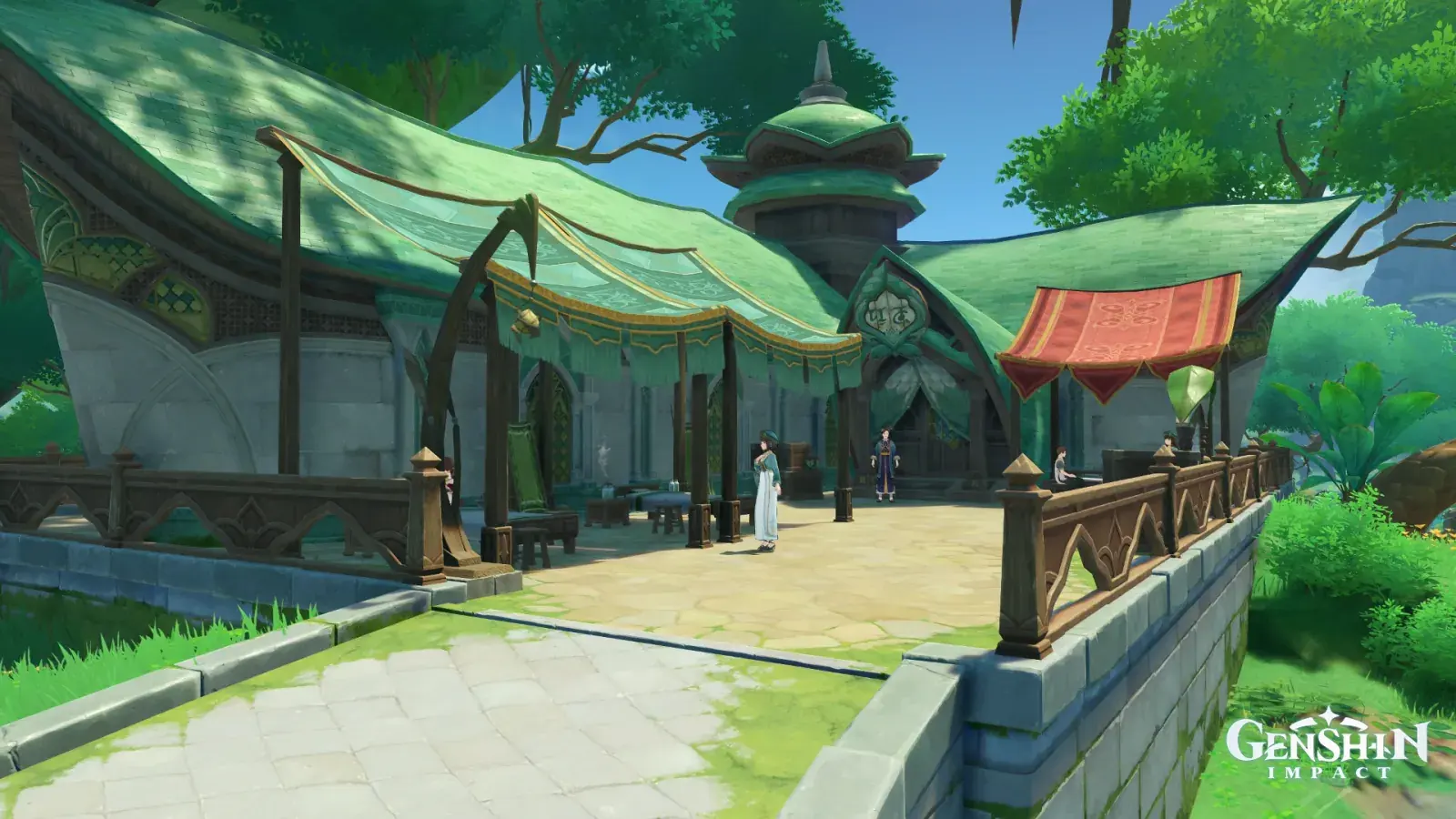
SumeruDayVentilatedConvalescentGreen and Moist
Bimarstan under a Green Awning
Palette
Click a swatch to copy its HEX; hover for the OKLCH value.
Reconstructed gradient
The gradient distilled from the scene, unrolled left to right by stop; the authored angle is 180° (used by the hero and exports), while gallery cards share a uniform 135° sweep.
0%5c9ccc20%63977638%cb745e58%2e3f3574%cfc999100%2e7130
Why it works
A piece of cloth can serve as a fill light, and the hue it hands over is more precise than the sky's. The green cloth awning crossing the left half runs 54,237 pixels at L 0.63 / chroma 0.075 / hue 156°; the sandstone floor beneath it runs 7,920 pixels at L 0.35 / chroma 0.029 / 159° — 3°. The same sandstone, stepped out from under the awning into direct sun, reads L 0.83 / chroma 0.065 / 102°: one piece of cloth swung a floor's hue by 57°. The condition is written into the same picture — the vermilion canopy on the right is only 9,568 pixels, and the wooden stall beneath it still reads 155°, with not a trace of red. Fill light is billed by how much sky it blocks, never by how loud it is; in this batch, the 53,418 pixels of red bunting in «Lambad's Tavern under Open Sky» hang too high and collect nothing at all.
Take these colours with you
CSS variables, a Tailwind v4 theme or SVG — one click to copy into your project.
/* Bimarstan under a Green Awning · Bimarstan under a Green Awning — Teyvat Palette */
:root {
  --gap-sky: oklch(0.67 0.097 242); /* Gap Sky #5c9ccc */
  --awning-jade: oklch(0.63 0.075 156); /* Awning Jade #639776 */
  --vermilion-canopy: oklch(0.65 0.114 35); /* Vermilion Canopy #cb745e */
  --awning-shade-floor: oklch(0.35 0.029 159); /* Awning-Shade Floor #2e3f35 */
  --sunlit-sandstone: oklch(0.83 0.065 102); /* Sunlit Sandstone #cfc999 */
  --sunlit-grass: oklch(0.49 0.12 144); /* Sunlit Grass #2e7130 */
  --gradient-bimarstan: linear-gradient(180deg, oklch(0.67 0.097 242) 0%, oklch(0.63 0.075 156) 20%, oklch(0.65 0.114 35) 38%, oklch(0.35 0.029 159) 58%, oklch(0.83 0.065 102) 74%, oklch(0.49 0.12 144) 100%);
}A 1080×1350 PNG carrying the scene, its palette and every value — save it and post it as is.