Teyvat PaletteTeyvat colour cards
Scene library
GitHub
Gallery
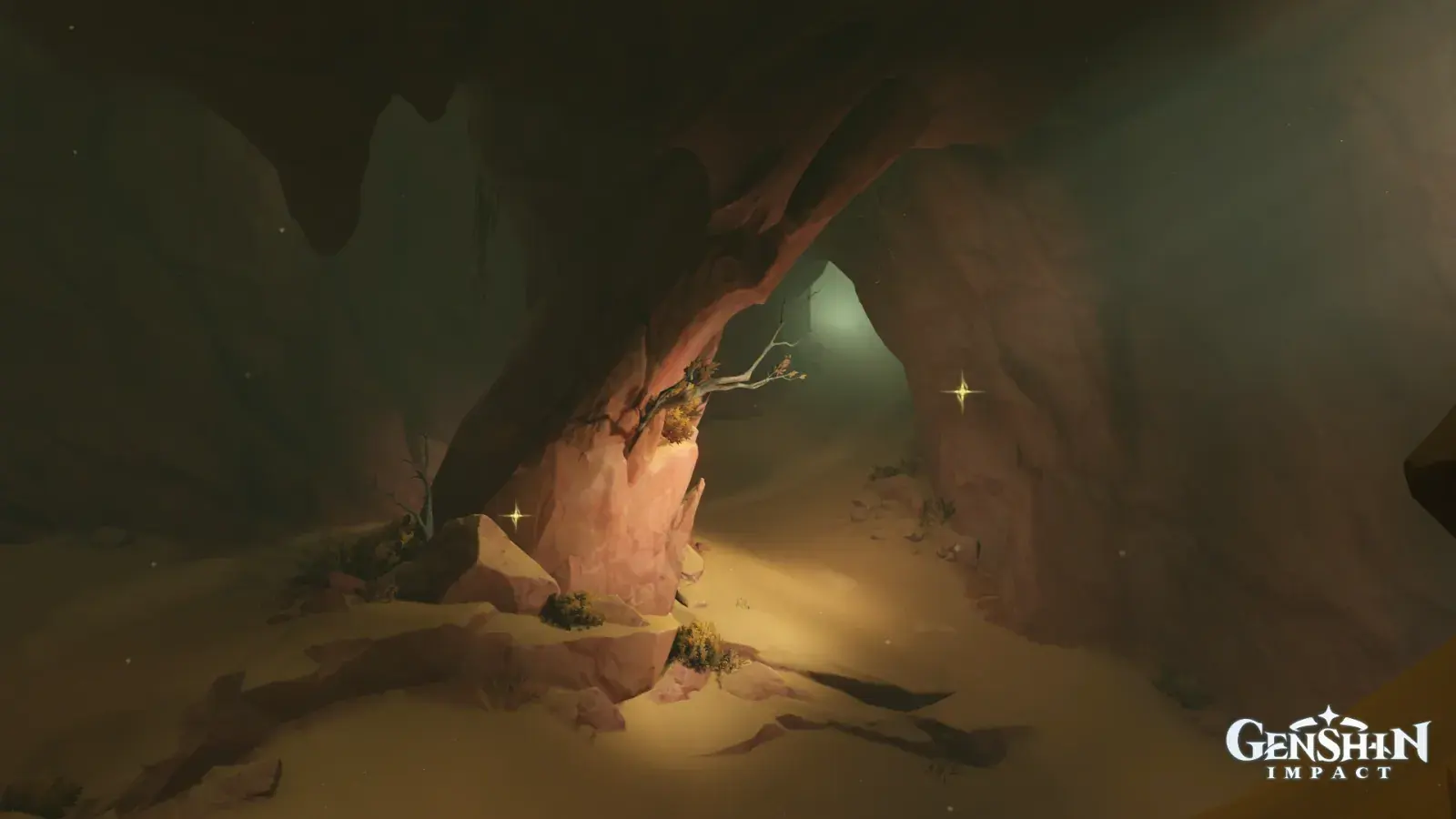
Wenut Tunnels by Sandlight
SumeruEnclosedWarm-airedStill

Wenut Tunnels by Sandlight

Palette

Click a swatch to copy its HEX; hover for the OKLCH value.

Reconstructed gradient

The gradient distilled from the scene, unrolled left to right by stop; the authored angle is 180° (used by the hero and exports), while gallery cards share a uniform 135° sweep.

0%24221542%3a321d74%c88758100%a77d43

Why it works

Where there is no daylight, the colour of a large surface belongs to the light and not to the material. One and the same sandstone reads L 0.68, chroma 0.102, hue 56° on the pillar face that squares up to the sand, and L 0.25, chroma 0.023, hue 103° on the vault the light never reaches — the material never changes once along the way, yet hue travels a monotonic 47° and chroma falls to a quarter. A cavern's ambient colour is not the rock's own colour; it is the hue that remains once the light has run out.

01

The light comes up from underfoot

Of the brightest 4000 pixels, 2549 land on the sand floor at (0.50, 0.73), measuring L 0.76, chroma 0.105, hue 77°. The most saturated 4000 are that same floor and the pillar it lights — (0.49, 0.70) at chroma 0.109 and (0.45, 0.58) at chroma 0.110. Only two small clusters are brighter than the sand: 50 pixels and 26 pixels, two motes of dust hanging in the air at L 0.84 and 0.85. There is not an inch of sky in the frame, and the ground takes both crowns, lightness and chroma. When you build a space with no daylight, first decide which plane is bouncing the light, then hand that plane the highest lightness and the highest chroma together. Painting the source as a bright point does less than painting it as a lit floor.

02

One rock, four hues

Take four steps upward from the sand: the pillar face square to the light at L 0.68, chroma 0.102, hue 56°; the sand at 0.62, 0.092, 74°; the shaded underside of the arch at 0.32, 0.036, 88°; the vault at 0.25, 0.023, 103°. All three channels move monotonically, and all four places are the same sandstone. The Geode Mine Shaft study followed a crystal column from 114° to 186°, but that was a move toward the cavern wall's ambient 225° — that cave had two things emitting colour, the column and the wall, each saying its own thing. Here there is no second thing. The rock states no hue of its own; which hue it shows depends on how much light still reaches it. Stop assigning a local colour to a rock wall and then darkening everything uniformly — darkening alone yields shades of one hue, never depth.

03

One lamp earns only half the wheel

Search the whole frame for 165°–345° and not a single pixel clears the grey threshold. Everything crowds into 15°–165°: the yellow band 50.36%, green 25.61%, orange 0.17%, achromatic pixels 23.85%, and a chroma median of only 0.031. The one elsewhere is the mouth of the next tunnel in the distance; its green pixels measure L 0.49, chroma 0.047, hue 119° — greener than the vault's 103°, and still inside the same semicircle. A space with one light source gets this much of the colour wheel and no more. If you want a second hue, give it a second lamp, not a second kind of stone.

Take these colours with you

CSS variables, a Tailwind v4 theme or SVG — one click to copy into your project.

/* Wenut Tunnels by Sandlight · Wenut Tunnels by Sandlight — Teyvat Palette */
:root {
  --sandlight-gold: oklch(0.62 0.092 74); /* Sandlight Gold #a77d43 */
  --lit-pillar: oklch(0.68 0.102 56); /* Lit Pillar #c88758 */
  --dust-mote: oklch(0.84 0.103 101); /* Dust Mote #d9cd7c */
  --arch-underside: oklch(0.32 0.036 88); /* Arch Underside #3a321d */
  --unlit-vault: oklch(0.25 0.023 103); /* Unlit Vault #242215 */
  --far-passage: oklch(0.49 0.047 119); /* Far Passage Green #5d6446 */
  --gradient-wenut-tunnels: linear-gradient(180deg, oklch(0.25 0.023 103) 0%, oklch(0.32 0.036 88) 42%, oklch(0.68 0.102 56) 74%, oklch(0.62 0.092 74) 100%);
}

A 1080×1350 PNG carrying the scene, its palette and every value — save it and post it as is.