Teyvat PaletteTeyvat colour cards
Scene library
GitHub
Gallery
Wavechaser Plain under a Clear Sky
Nod-KraiDayLimpidWide OpenBright

Wavechaser Plain under a Clear Sky

Palette

Click a swatch to copy its HEX; hover for the OKLCH value.

Reconstructed gradient

The gradient distilled from the scene, unrolled left to right by stop; the authored angle is 180° (used by the hero and exports), while gallery cards share a uniform 135° sweep.

0%88b9ed24%abe5fc32%6ebcfc44%6b9fdb62%4889bd100%688f65

Why it works

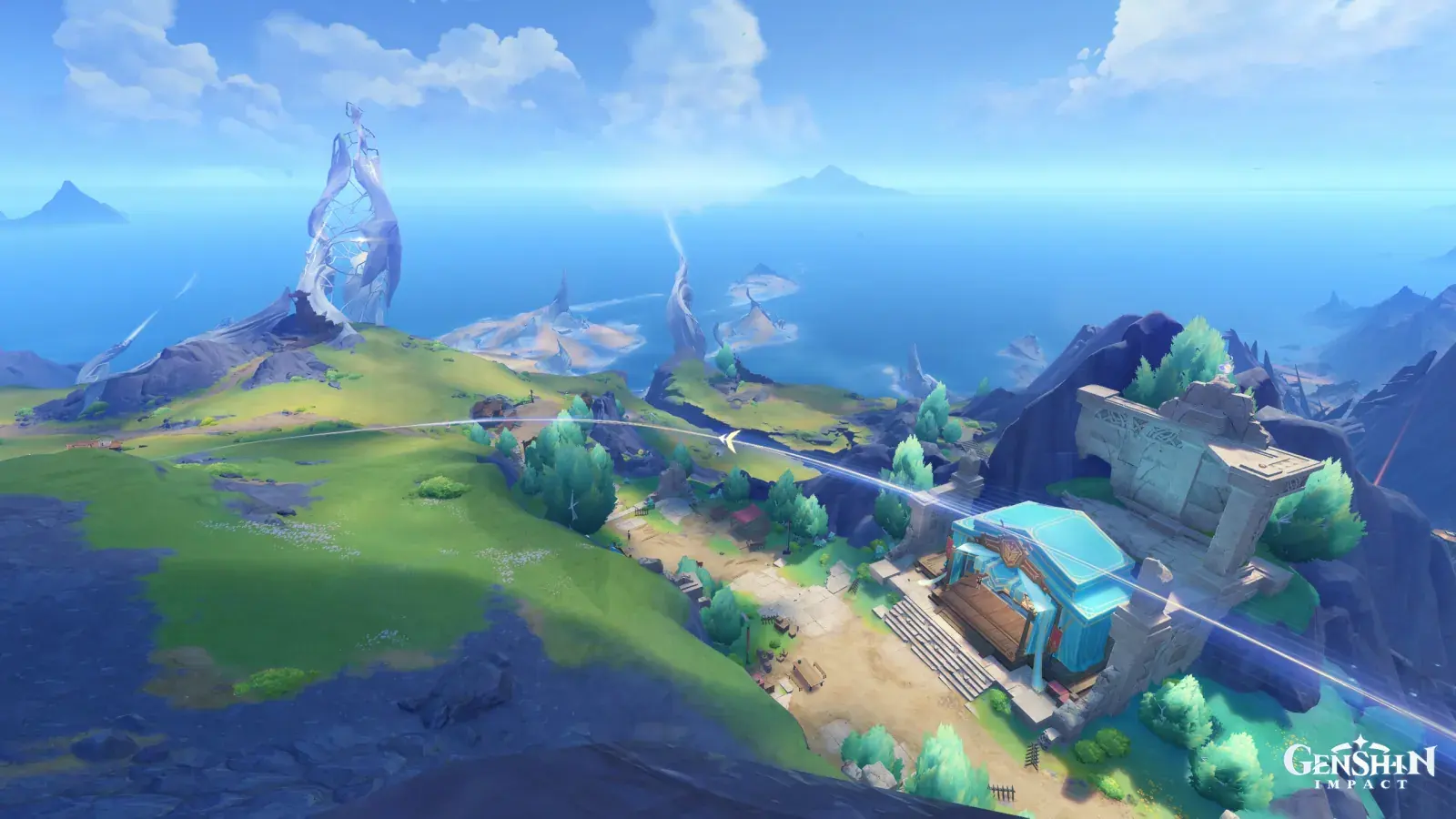
A boundary need not be a break; it can be an extremum. The zenith measures 251°/L 0.77/chroma 0.091 and the sea 253°/L 0.69/chroma 0.105 — 2° apart in hue, 0.08 in lightness, 1.15× in chroma. Almost the same colour, and nobody confuses them. What separates them is the band lying between sea and sky at L 0.89, chroma 0.067: brighter than either side and paler than either side, so both sides are walking away from it.

01

The peak in brightness and the trough in chroma share one band

Sampled top to bottom in a column: zenith 251°/L 0.77/chroma 0.091 → the horizon band 224°/0.89/0.067 → the water below it 245°/0.77/0.120 → mid water 253°/0.69/0.105 → near water 245°/0.61/0.104. Lightness spikes on the band and chroma dips on the very same band. Of the frame's 4000 brightest pixels, 3336 fall on that single horizontal strip at y≈0.22, at L 0.93 — and their chroma tops out at 0.068. The frame's chroma peak of 0.166 sits instead in the deep water at lightness 0.61–0.69: 3966 of the 4000 most chromatic pixels land in 240°–270°, at (0.39, 0.39). In this picture bright and vivid are strictly opposed quantities.

02

Everything standing in the sea is the sea's colour

The crystal spire growing out of the water on the left looks white; measured whole it is 252°, L 0.76, chroma 0.095 — a shade more chromatic than the sky directly above it (251°, 0.091). The blue tiled roof of the pavilion beside the stone gate at bottom right is 227°, L 0.75, chroma 0.072, still inside the blue band. 210°–270° holds 73.86% of the frame: sky, sea, spire and roof all belong to one family, and achromatic pixels are only 3.07%. The single large surface outside that family is the meadow on the left — 13.31%, 143°, chroma 0.076 — and what it leans on is hue, not chroma.

03

One horizon, two ways to draw it

«Moontide Sea at Night» broke lightness and chroma together right on the boundary: above the line L 0.13/chroma 0.026, below it L 0.70/chroma 0.137 — a lightness gap of 0.57 and a chroma ratio of 5.3, and that made a single line the protagonist. Same Nod-Krai horizon here, and the two sides differ by 0.08 in lightness and 1.15× in chroma. The line itself barely exists; all the work is done by the L 0.89/0.067 band laid across the seam. To separate two nearly identical fields you need not change one's hue or sink it darker. Lay a bright, pale band on the seam and both sides sort themselves out — and the picture stays one hue.

Take these colours with you

CSS variables, a Tailwind v4 theme or SVG — one click to copy into your project.

/* Wavechaser Plain under a Clear Sky · Wavechaser Plain under a Clear Sky — Teyvat Palette */
:root {
  --zenith-blue: oklch(0.77 0.091 251); /* Zenith Blue #88b9ed */
  --horizon-band: oklch(0.89 0.067 224); /* Horizon Band #abe5fc */
  --far-water: oklch(0.77 0.12 245); /* Far Water #6ebcfc */
  --deep-water: oklch(0.61 0.104 245); /* Deep Water #4889bd */
  --slope-meadow: oklch(0.61 0.076 143); /* Slope Meadow #688f65 */
  --crystal-spire: oklch(0.76 0.095 252); /* Crystal Spire #84b5ec */
  --pavilion-roof: oklch(0.75 0.072 227); /* Pavilion Roof #7cb8d2 */
  --gradient-wavechaser-plain: linear-gradient(180deg, oklch(0.77 0.091 251) 0%, oklch(0.89 0.067 224) 24%, oklch(0.77 0.12 245) 32%, oklch(0.69 0.105 253) 44%, oklch(0.61 0.104 245) 62%, oklch(0.61 0.076 143) 100%);
}

A 1080×1350 PNG carrying the scene, its palette and every value — save it and post it as is.