Teyvat PaletteTeyvat colour cards
Scene library
GitHub
Gallery
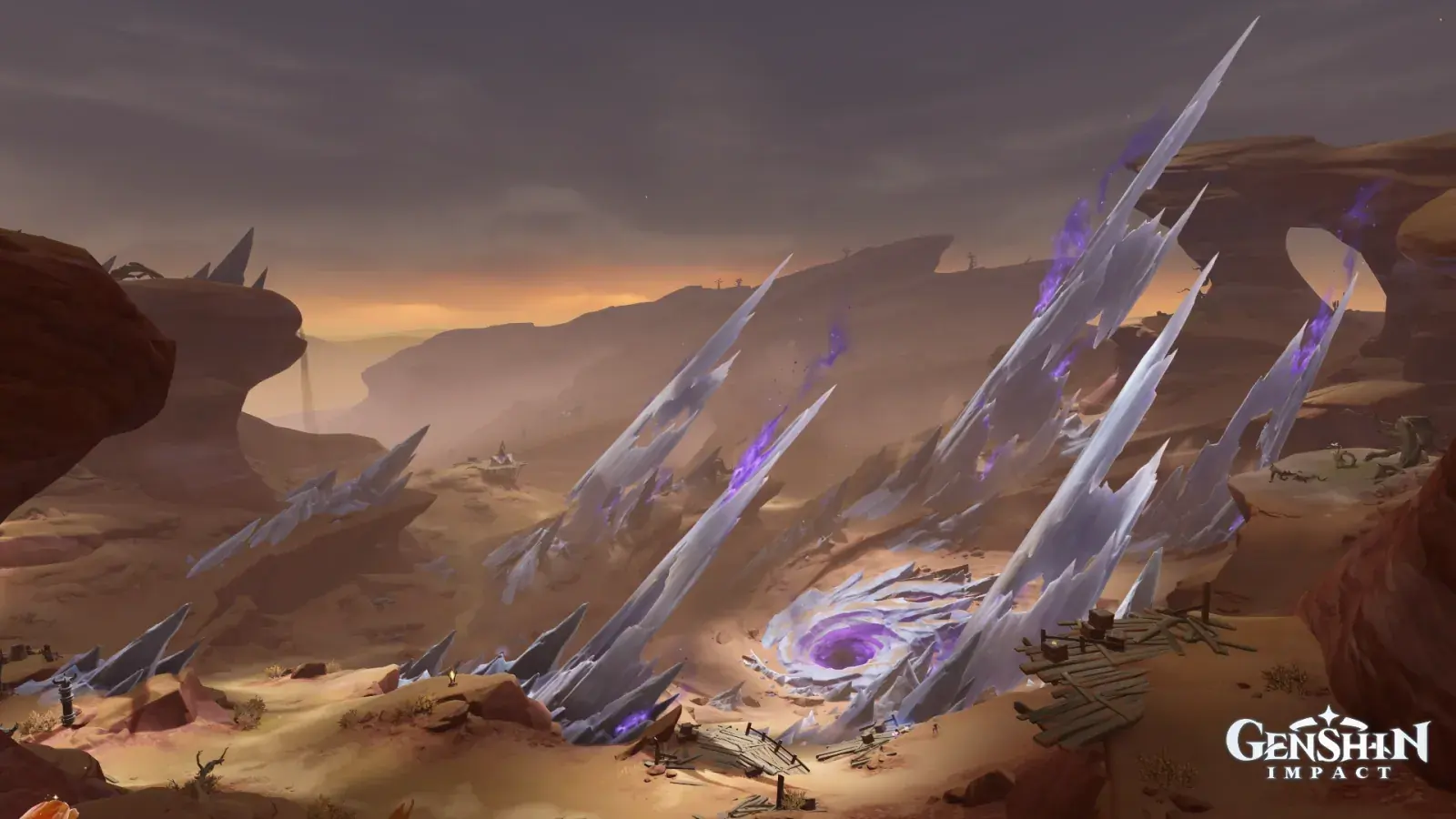
Tunigi Hollow, Crystals at Dusk
SumeruDuskDesolateCorrodedDust Dusk

Tunigi Hollow, Crystals at Dusk

Palette

Click a swatch to copy its HEX; hover for the OKLCH value.

Reconstructed gradient

The gradient distilled from the scene, unrolled left to right by stop; the authored angle is 180° (used by the hero and exports), while gallery cards share a uniform 135° sweep.

0%5a4f5534%b6816650%63453c66%d0cbda82%9664ca100%764d32

Why it works

To make something read as "not from here", you do not need to give it an opposing hue — take its hue away entirely, then grow on that same object the one cluster that crosses the local ceiling. Across the whole of Tunigi Hollow the window `130-230`, 100° wide, returns nothing matched; widened to 90°–270°, half the colour wheel, it still holds only 105 pixels (0.012%). There is not one cool pixel in the picture. Yet the shards driven diagonally across the frame take 2,078 of the brightest 4000 pixels at chroma 0.019–0.023, all of them under the achromatic line of 0.025, while sand of exactly the same brightness (1,791 pixels, L 0.84) measures 0.051. The abyssal violet wound around those same shards holds the most chromatic 1,513 pixels of 270°–345° at chroma 0.157, peaking at 0.214 — 1.67 times the 0.094 of the most chromatic 3% of the sandstone family, which covers 61.25%. Absence does the work of "not from here"; trespass does the work of "stronger than here"; and both are charged to the same object.

01

Not one cool pixel in the whole frame

The window `130-230`, 100° wide, returns nothing matched across the entire picture. Widened to 120°–240° it holds 1 pixel; widened to 90°–270°, half the colour wheel, 105 pixels, or 0.012%. The eye nonetheless reports a grey-violet overcast and a stand of icy blue crystal — and that sky measures 60,630 pixels at L 0.44 / chroma 0.018, with a maximum of 0.026 and not one pixel over the achromatic line. «Voidsea Outlook in Cavern Blue» said a strong enough monochrome field will paint your neutral highlight in the complement for free; here the field is 61.25% of orange-yellow sandstone, and the complement it prints is exactly that blue which does not exist. If you want cold, first measure how thick your warm is — thick enough, and you buy a surface that makes no sound instead of a cool hue.

02

Two surfaces of equal brightness, two times apart in chroma

The brightest 4000 pixels go almost entirely to two things: 2,078 to the lit ridges of the shards at L 0.84–0.86 / chroma 0.019–0.023, and 1,791 to the foreground sand the setting sun still reaches, at L 0.84 / 0.051 / hue 34°. Equally bright, and the sand carries more than twice the chroma. This is also where the picture's hour comes from — the light arrives from a warm band of 5,191 pixels along the horizon (L 0.65 / 0.076 / 49°) which is 0.21 brighter than the 0.44 at the zenith: the bright part is the horizon, not the sky above. «Mt. Damavand behind a Curtain of Dust» separated the grey of air from the grey of material by measuring the near and far ends of one object; this picture offers a different ruler: inside one frame, find a local material of equal lightness and compare chroma. The surface that is both bright and empty came from somewhere else.

03

The local ceiling is crossed by the outsider

The sandstone family covers 61.25% (orange 34.99% plus yellow 26.26%), and its most chromatic 3% (16,178 pixels) reads chroma 0.094 with a peak of 0.152. The violet-and-pink family covers only 5.73%, yet its most chromatic 3% (1,513 pixels) reads 0.157 with a peak of 0.214 — 1.67 times over. Nor is that violet scattered: the middle band of the frame holds 38,083 such pixels peaking at 0.214, while the left third holds 939 peaking at 0.052. Wherever it grows, there is a shard. So one and the same crystal owns both this picture's chroma floor, 0.019, and its ceiling, 0.214, with only a few pixels between the two extremes. To paint something being corroded, put the emptiest stroke and the dirtiest stroke on the same object — split them, and all that is left is a pale rock and a clot of violet with nowhere to live.

Take these colours with you

CSS variables, a Tailwind v4 theme or SVG — one click to copy into your project.

/* Tunigi Hollow, Crystals at Dusk · Tunigi Hollow, Crystals at Dusk — Teyvat Palette */
:root {
  --dust-sky: oklch(0.44 0.018 341); /* Dust Sky #5a4f55 */
  --horizon-band: oklch(0.65 0.076 49); /* Horizon Band #b68166 */
  --mesa-ochre: oklch(0.42 0.044 36); /* Mesa Ochre #63453c */
  --shard-white: oklch(0.85 0.021 300); /* Shard White #d0cbda */
  --abyss-flame: oklch(0.6 0.157 305); /* Abyss Flame #9664ca */
  --near-sand: oklch(0.46 0.068 54); /* Near Sand #764d32 */
  --gradient-tunigi-hollow: linear-gradient(180deg, oklch(0.44 0.018 341) 0%, oklch(0.65 0.076 49) 34%, oklch(0.42 0.044 36) 50%, oklch(0.85 0.021 300) 66%, oklch(0.6 0.157 305) 82%, oklch(0.46 0.068 54) 100%);
}

A 1080×1350 PNG carrying the scene, its palette and every value — save it and post it as is.