Teyvat PaletteTeyvat colour cards
Scene library
GitHub
Gallery
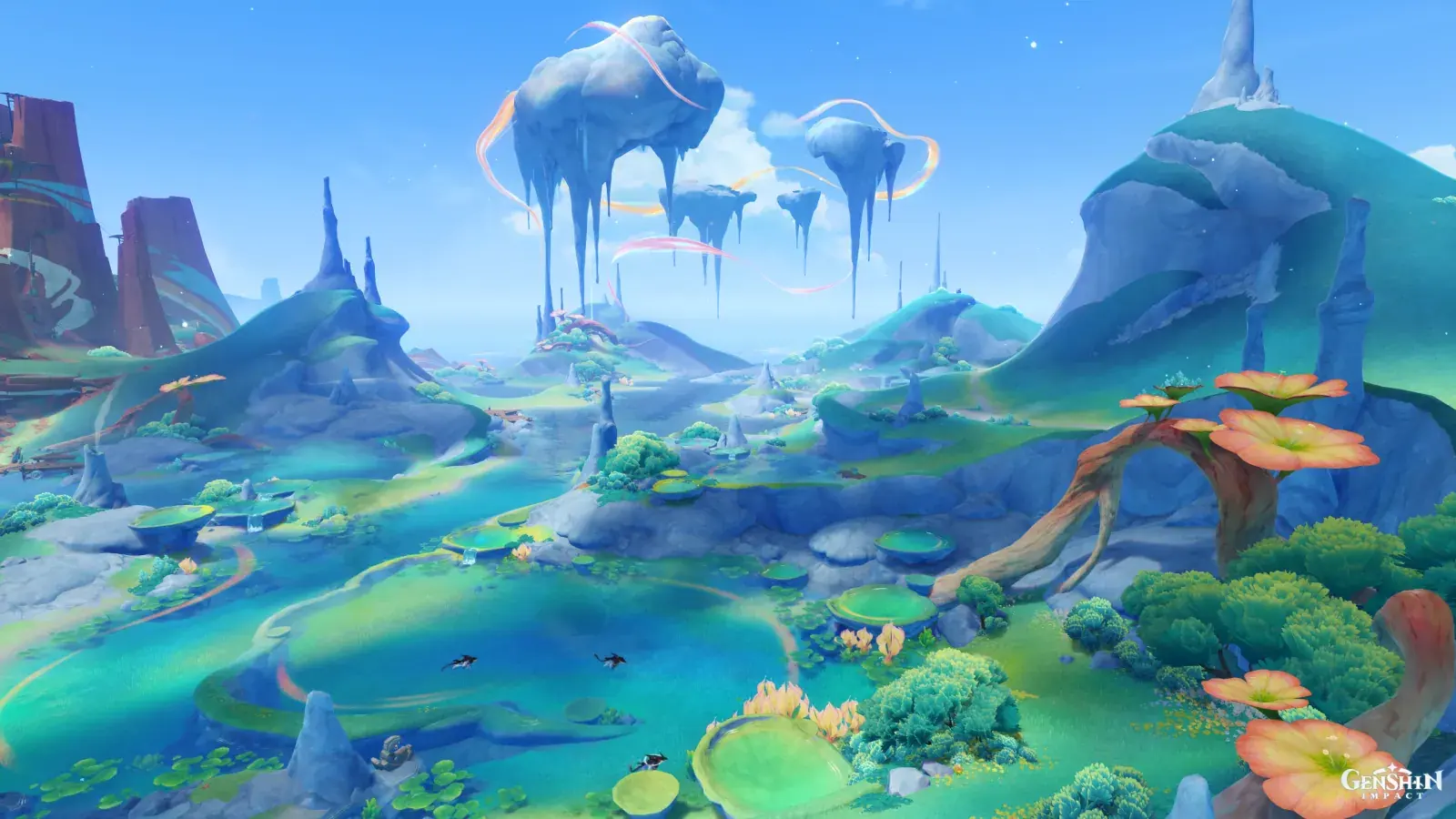
Toyac Springs in Turquoise Daylight
NatlanDayLimpidAbundantOpen

Toyac Springs in Turquoise Daylight

Palette

Click a swatch to copy its HEX; hover for the OKLCH value.

Reconstructed gradient

The gradient distilled from the scene, unrolled left to right by stop; the authored angle is 180° (used by the hero and exports), while gallery cards share a uniform 135° sweep.

0%68b0f832%8cc6ec60%0084a684%6cc888100%cc6e58

Why it works

When 98.82% of the pixels carry colour, the quota is down to 0.051 (p99 0.152 minus median 0.101) — the lowest of the four in this batch. The consequence is measurable: the ceiling of 0.204 is eaten by the largest surface (2,509 of the 4,000 most chromatic pixels land in the 240°–270° sky and deep water), while the only warm colour in the frame — and the subject anyone finds first, those peach blooms on the right bank — holds 11,420 pixels in 15°–75° (1.24%) and reaches only 0.124 even in its most chromatic 3%, a full 0.080 below the ceiling. To make a small element the subject, do not add chroma to it (it cannot get there); find it a surface nearby that will give chroma up.

01

Not an inch was yielded

Only 1.18% of the frame is achromatic. Sky, water, grass, floating leaves, rock — every one of them sits at a chroma of 0.08–0.13: the sky along the top at L 0.74 / 0.128, the pads and shallow weed at the bottom at L 0.76 / 0.129, the deep water in front at L 0.57 / 0.108, the hills in shade at the left at L 0.58 / 0.088, and even the haze-flattened horizon at 0.081. That is how a median of 0.101 gets built. A median is not how vivid a picture is on average; it is how much of its area refused to keep quiet. Here the answer is nearly all of it.

02

The subject cannot afford the ceiling

The peach blooms on the right bank are the only warm colour in the picture. Across the whole frame 15°–75° holds just 11,420 pixels (1.24%); the warm pixels inside the rectangle around the blooms measure L 0.65 / chroma 0.087, and the most chromatic 3% of all warm pixels reaches only L 0.64 / 0.124 / hue 34°. The peak of 0.204, meanwhile, belongs to the 240°–270° blue of the sky and the deep water. The blooms sit 0.080 under the ceiling and are still where the eye goes first — because green, teal and blue take 94.61% between them, and that hue is the only one of its kind here. When the quota is spent, the one way left to buy a focus is to share a colour with nobody.

03

Two families split the most chromatic four thousand

The 4,000 most chromatic pixels divide between two places 104° apart: 2,509 in the 240°–270° sky and deep water (peak 0.204), and 1,290 in the 150°–180° shallow weed (peak 0.168); the most chromatic 3% of 120°–180° measures L 0.80 / chroma 0.155. Both reach up near the ceiling and neither puts the other down. What saves it is that the hues run continuously — green 7.79% into teal 14.81% into blue 72.01%, with no rung missing — so it reads as one body of moving water rather than three pasted panels. To build depth in a picture with no quota left, lay the hues out as a ramp with no gaps instead of asking which one is more vivid.

Take these colours with you

CSS variables, a Tailwind v4 theme or SVG — one click to copy into your project.

/* Toyac Springs in Turquoise Daylight · Toyac Springs in Turquoise Daylight — Teyvat Palette */
:root {
  --zenith-blue: oklch(0.74 0.128 250); /* Zenith Blue #68b0f8 */
  --far-shoal: oklch(0.8 0.081 238); /* Far Shoal #8cc6ec */
  --deep-pool: oklch(0.57 0.108 224); /* Deep Pool #0084a6 */
  --lilypad-teal: oklch(0.76 0.129 152); /* Lilypad Teal #6cc888 */
  --peach-bloom: oklch(0.64 0.124 34); /* Peach Bloom #cc6e58 */
  --gradient-toyac-springs: linear-gradient(180deg, oklch(0.74 0.128 250) 0%, oklch(0.8 0.081 238) 32%, oklch(0.57 0.108 224) 60%, oklch(0.76 0.129 152) 84%, oklch(0.64 0.124 34) 100%);
}

A 1080×1350 PNG carrying the scene, its palette and every value — save it and post it as is.