Gallery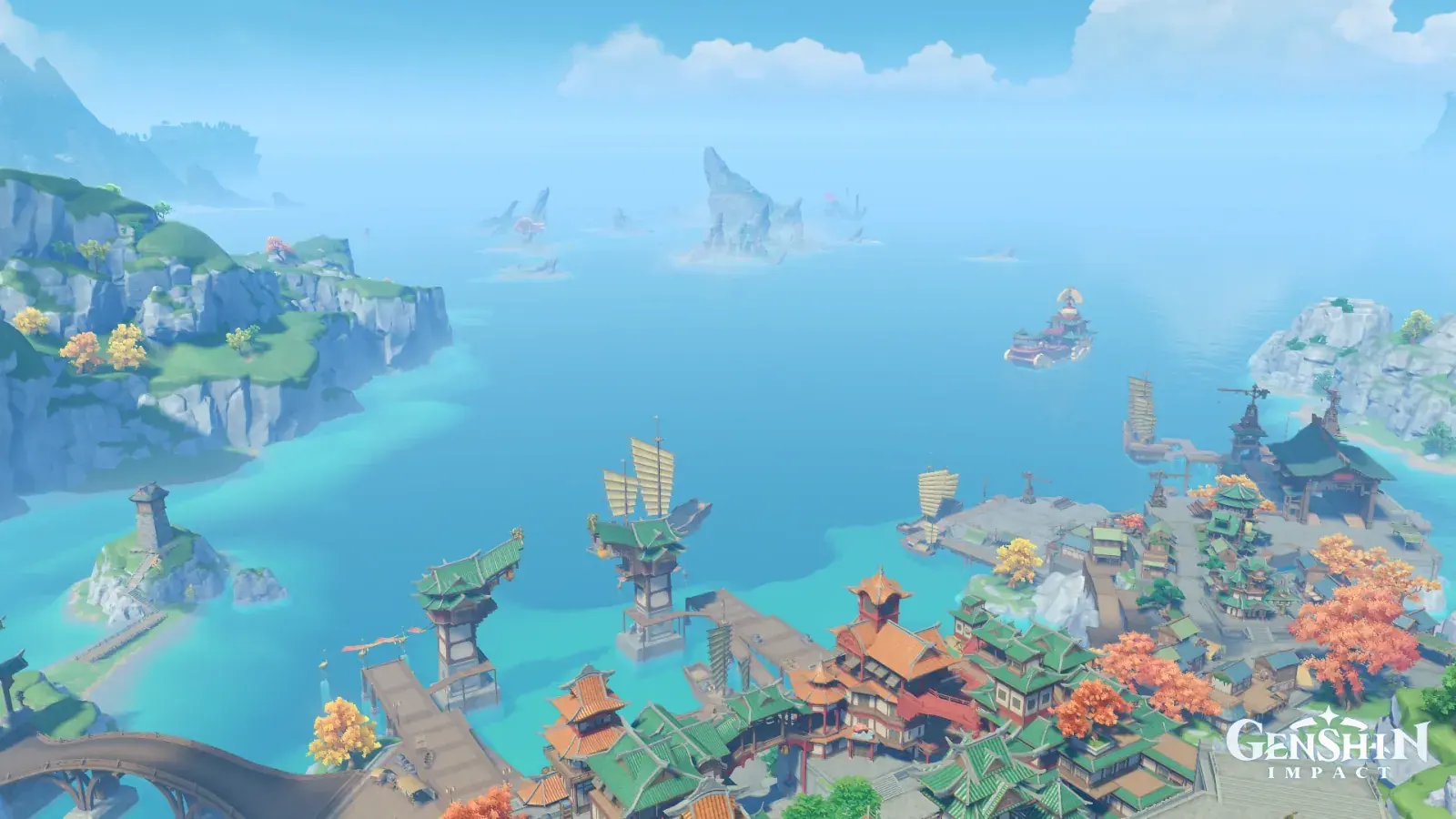
LiyueDayVastBustlingFar-seeing
The Sea of Clouds in Far Light
Palette
Click a swatch to copy its HEX; hover for the OKLCH value.
Reconstructed gradient
The gradient distilled from the scene, unrolled left to right by stop; the authored angle is 180° (used by the hero and exports), while gallery cards share a uniform 135° sweep.
0%c9e2f630%7cbadc55%629fb576%67b4b2100%c6907a
Why it works
For a white to be the light, it has to move away from its neighbour's hue — or hold no hue at all. Cut its chroma in half and it is still just sky. The 4000 brightest pixels of the Sea of Clouds sit in two cells along the top edge at L 0.90 and 0.89, chroma 0.039 and 0.042, both at hue 243° — genuinely more than half off the 0.086 of the sky overhead. But 243° stands only 10° from the 233° mean of the blue band that covers 76.02% of the frame, so it is absorbed back into the sky and reads as farther away, not as light. This picture therefore has no light source, and its focus has to be earned by the bottom edge on its own.
Take these colours with you
CSS variables, a Tailwind v4 theme or SVG — one click to copy into your project.
/* The Sea of Clouds in Far Light · The Sea of Clouds in Far Light — Teyvat Palette */
:root {
  --cloud-rim: oklch(0.9 0.039 243); /* Cloud Rim #c9e2f6 */
  --sea-sky: oklch(0.76 0.08 233); /* Sea-and-Sky Blue #7cbadc */
  --cliff-shadow: oklch(0.67 0.071 222); /* Cliff Shadow #629fb5 */
  --shoal-jade: oklch(0.72 0.077 193); /* Shoal Jade #67b4b2 */
  --eave-vermilion: oklch(0.7 0.074 43); /* Eave Vermilion #c6907a */
  --gradient-sea-of-clouds: linear-gradient(180deg, oklch(0.9 0.039 243) 0%, oklch(0.76 0.08 233) 30%, oklch(0.67 0.071 222) 55%, oklch(0.72 0.077 193) 76%, oklch(0.7 0.074 43) 100%);
}A 1080×1350 PNG carrying the scene, its palette and every value — save it and post it as is.