Teyvat PaletteTeyvat colour cards
Scene library
GitHub
Gallery
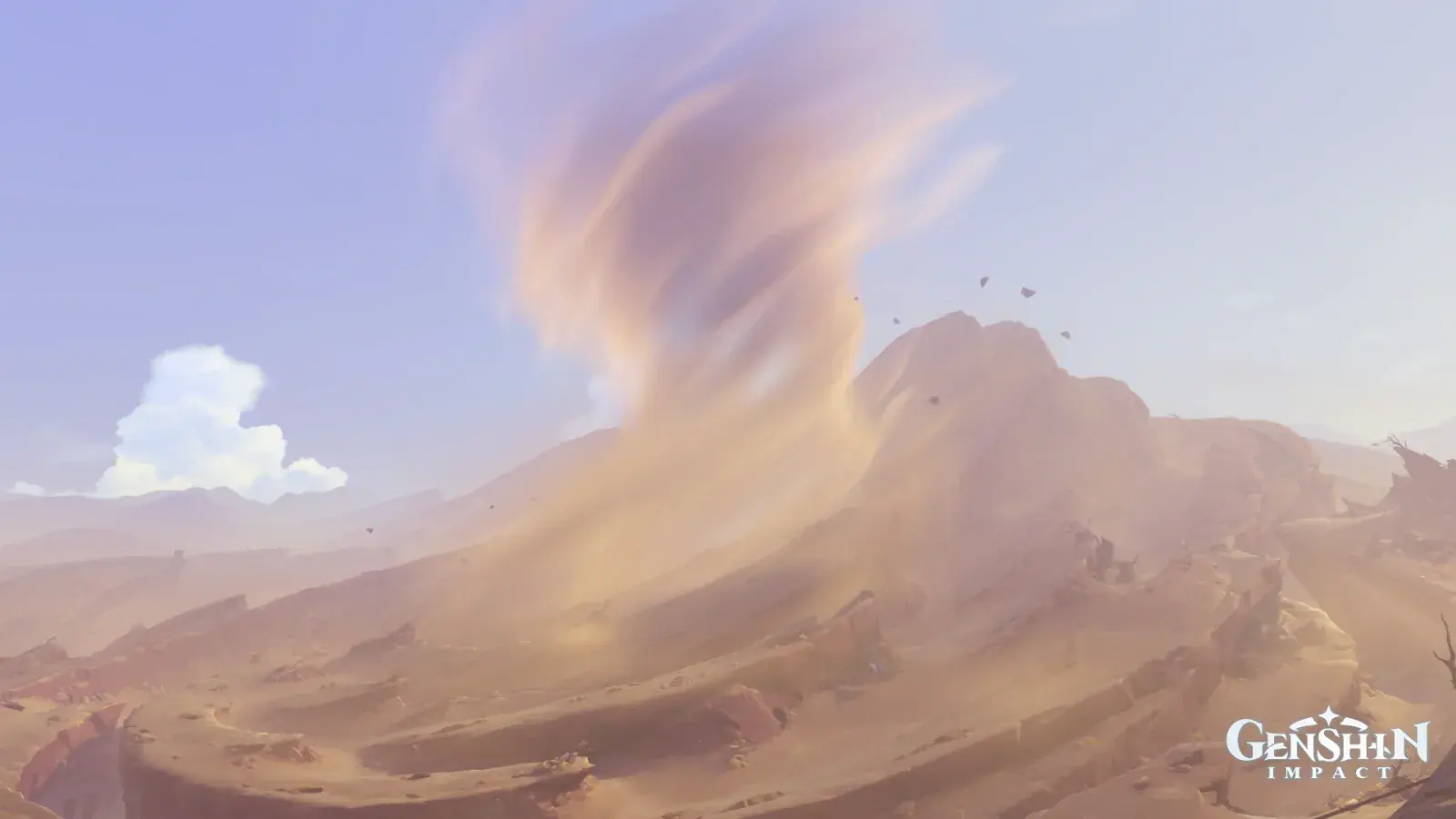
Mt. Damavand behind a Curtain of Dust
SumeruDayObscuredScorched whiteVacant

Mt. Damavand behind a Curtain of Dust

Palette

Click a swatch to copy its HEX; hover for the OKLCH value.

Reconstructed gradient

The gradient distilled from the scene, unrolled left to right by stop; the authored angle is 180° (used by the hero and exports), while gallery cards share a uniform 135° sweep.

0%a9afe730%c6acb855%cbc0ca100%a67f6c

Why it works

When the air is more saturated than the nearest patch of ground, the picture no longer has a foreground: Damavand's sky measures chroma 0.080 while the dunes along the bottom edge reach only 0.052, and 3995 of the 4000 most chromatic pixels are sky at 279°. Measured on the same ruler, the same Sumeru desert in Desert of Hadramaveth, Sandstorm carries its violet haze at chroma 0.075 with just 1.87% achromatic and a ceiling of 0.120; Damavand's curtain of dust bleaches instead — 16.43% achromatic, ceiling down to 0.091. To paint a dust storm that swallows the viewer too, don't merely fade the distance: push the nearest ground below the sky's chroma as well, or the viewer is watching from outside the curtain.

01

3995 of the four thousand most chromatic pixels are sky

Of the frame's 4000 most chromatic pixels, 3995 fall in 270°–300° at a mean of L 0.76 / chroma 0.084, centred at (0.10, 0.03) — the sky in the upper left. The other 5 are yellow, on the sand. Measured alone the sky is 0.080 / 279°, while the dunes along the bottom edge (rect from 0.40, 0.93) reach 0.056 and the stretch just left of them (rect from 0.35, 0.88) only 0.052. The most saturated thing in this picture is not any solid object; it is the sheet of dust hanging in front of every solid object. Once the foreground drops below the air, the sense of "you are standing here" is gone.

02

The same sandstone, four steps to below the grey line

Measure the same red sandstone at four depths: bottom edge, chroma 0.056 / L 0.63 / hue 48°; the middle-ground ridge, 0.045 / 0.65 / 37°; a layer further, 0.034 / 0.76 / 29°; the furthest ridge, 0.019 / 0.82 / 329° — the last step has fallen below the achromatic threshold of 0.025. Chroma falls monotonically, lightness rises monotonically, hue retreats steadily toward magenta: all three channels are collected by the dust at once. That is how the frame's 16.43% achromatic grew. It is not a neutral that was painted in; it is the bill that distance settled.

03

One cloud, and a 120° empty window

Of the brightest 4000 pixels, 3758 land on the single white cumulus at left, L 0.95 / chroma 0.009 — the only thing above the dust that was never dyed. And the 120°-wide window from 90°–210° holds zero pixels in the entire frame: no green, no cyan, and even the blue band is down to 0.45%. What remains is the sand in 345°–90° and the haze in 270°–345°. The curtain of dust did not only press the chroma down; it cut a third of the hue circle away. To paint "engulfed", deleting a whole stretch of hue works better than adding another white veil.

Take these colours with you

CSS variables, a Tailwind v4 theme or SVG — one click to copy into your project.

/* Mt. Damavand behind a Curtain of Dust · Mt. Damavand behind a Curtain of Dust — Teyvat Palette */
:root {
  --haze-violet: oklch(0.77 0.08 279); /* Haze Violet #a9afe7 */
  --dust-column: oklch(0.77 0.034 348); /* Dust Column Rose #c6acb8 */
  --dune-ochre: oklch(0.63 0.056 48); /* Dune Ochre #a67f6c */
  --far-ridge-grey: oklch(0.82 0.019 329); /* Far Ridge Grey #cbc0ca */
  --lone-cloud: oklch(0.95 0.009 192); /* Lone Cloud White #e8f0f0 */
  --gradient-mt-damavand: linear-gradient(180deg, oklch(0.77 0.08 279) 0%, oklch(0.77 0.034 348) 30%, oklch(0.82 0.019 329) 55%, oklch(0.63 0.056 48) 100%);
}

A 1080×1350 PNG carrying the scene, its palette and every value — save it and post it as is.