Teyvat PaletteTeyvat colour cards
Scene library
GitHub
Gallery
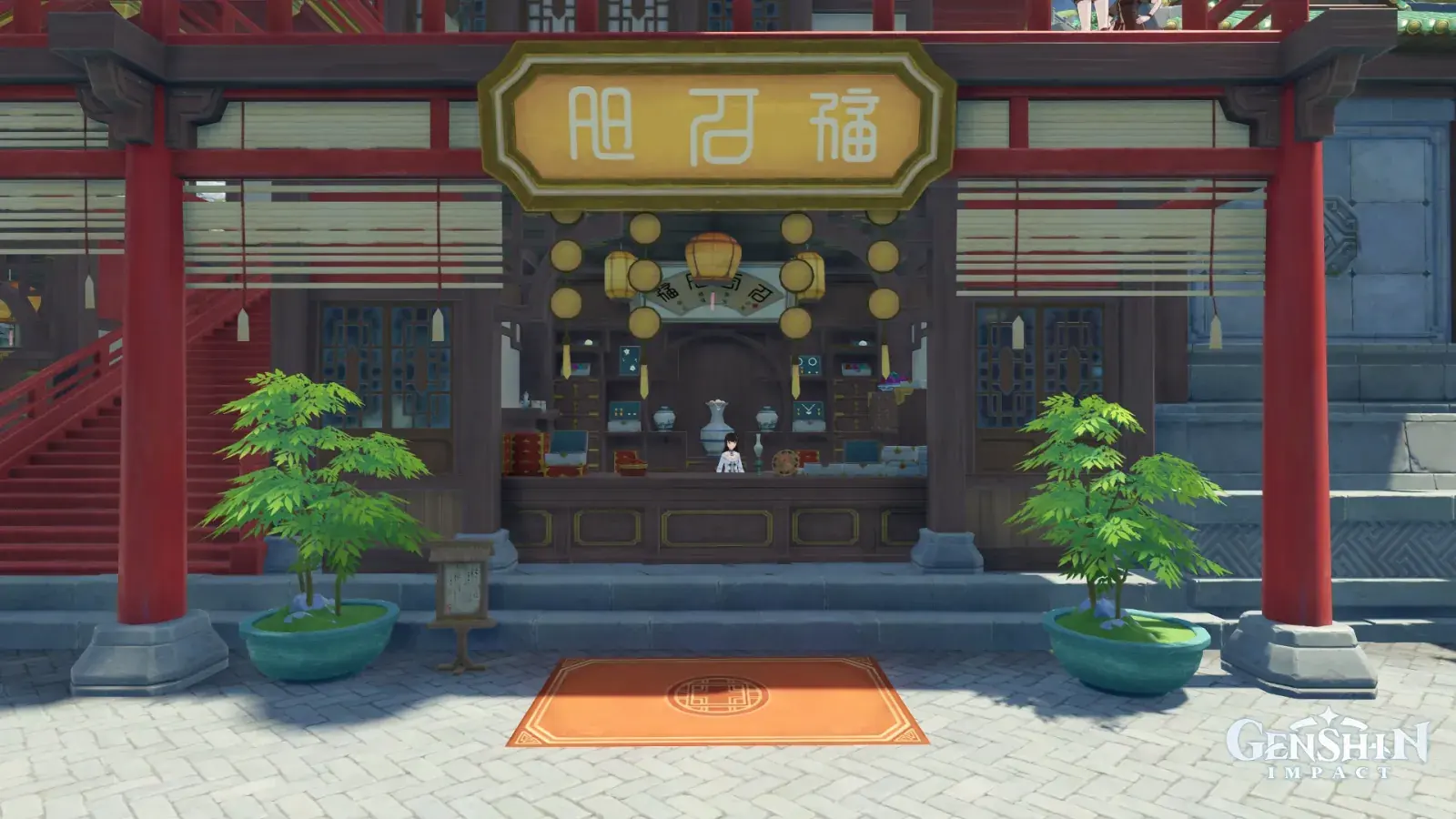
Mingxing Jewelry at High Noon
LiyueDayFormalEverydayComposed

Mingxing Jewelry at High Noon

Palette

Click a swatch to copy its HEX; hover for the OKLCH value.

Reconstructed gradient

The gradient distilled from the scene, unrolled left to right by stop; the authored angle is 350° (used by the hero and exports), while gallery cards share a uniform 135° sweep.

0%3b394222%59283646%46623170%8a7d4c100%c6cbb0

Why it works

Let the achromatics build the frame and colour is free to carry identity alone. Here 42.7% of pixels sit below the grey threshold at a median chroma of 0.032, and the lightness structure is held up by flagstones at L 0.83 — so the vermilion post and the shop shadow beside it can share L 0.35 and be separated by chroma alone (0.074 against 0.017).

01

One lightness, two identities, separated by chroma

The left-hand post measures L 0.35, chroma 0.074, hue 4°; the shadow deep in the shop, L 0.35 at chroma 0.017. Their lightness is identical — convert the frame to greyscale and they merge into one mass — yet the eye never confuses them, because one has colour and the other does not. This is the same rule as the Inverted City study seen from the other side: there, lightness had only twelve points of range left and chroma was forced to take over. Here lightness spans 0.25–0.90, and these two surfaces hand the job to chroma by choice.

02

Grey is not the absence of colour, it is making room

42.7% of pixels fall below the grey threshold at a median chroma of 0.032 — and nearly all of that grey is street and plaster: the brightest four thousand pixels average L 0.91 at chroma 0.017, at (0.49, 0.96) and (0.67, 0.95), which is the ground along the bottom of the frame. Because the street has claimed the top of the lightness range, the vermilion (17.3% across the red and orange bands) never has to compete on brightness to be seen. If you want a brand colour to be quietly prominent, first lay down an achromatic surface large and bright enough.

03

The two maples are the only living things, and the most saturated

The most saturated four thousand pixels average L 0.70, chroma 0.149, hue 132°, at (0.52, 0.56) — the pair of potted maples by the door. They account for only 14.5% in the green band, yet they are the frame's chroma peak, a shade above even the most vivid part of the vermilion post (L 0.56, chroma 0.145, 22°). Architectural colour is a fixed vocabulary: the vermilion, the blue-grey, the gold of the board are all decided by convention. So the highest chroma goes to the one thing in the frame that is free to grow.

Take these colours with you

CSS variables, a Tailwind v4 theme or SVG — one click to copy into your project.

/* Mingxing Jewelry at High Noon · Mingxing Jewelry at High Noon — Teyvat Palette */
:root {
  --eave-shadow: oklch(0.35 0.017 298); /* Eave Shadow #3b3942 */
  --vermilion-post: oklch(0.35 0.074 4); /* Vermilion Post #592836 */
  --potted-maple: oklch(0.46 0.08 133); /* Potted Maple #466231 */
  --signboard-gold: oklch(0.59 0.069 95); /* Signboard Gold #8a7d4c */
  --flagstone: oklch(0.83 0.037 115); /* Flagstone #c6cbb0 */
  --gradient-mingxing-jewelry: linear-gradient(350deg, oklch(0.35 0.017 298) 0%, oklch(0.35 0.074 4) 22%, oklch(0.46 0.08 133) 46%, oklch(0.59 0.069 95) 70%, oklch(0.83 0.037 115) 100%);
}

A 1080×1350 PNG carrying the scene, its palette and every value — save it and post it as is.