Teyvat PaletteTeyvat colour cards
Scene library
GitHub
Gallery
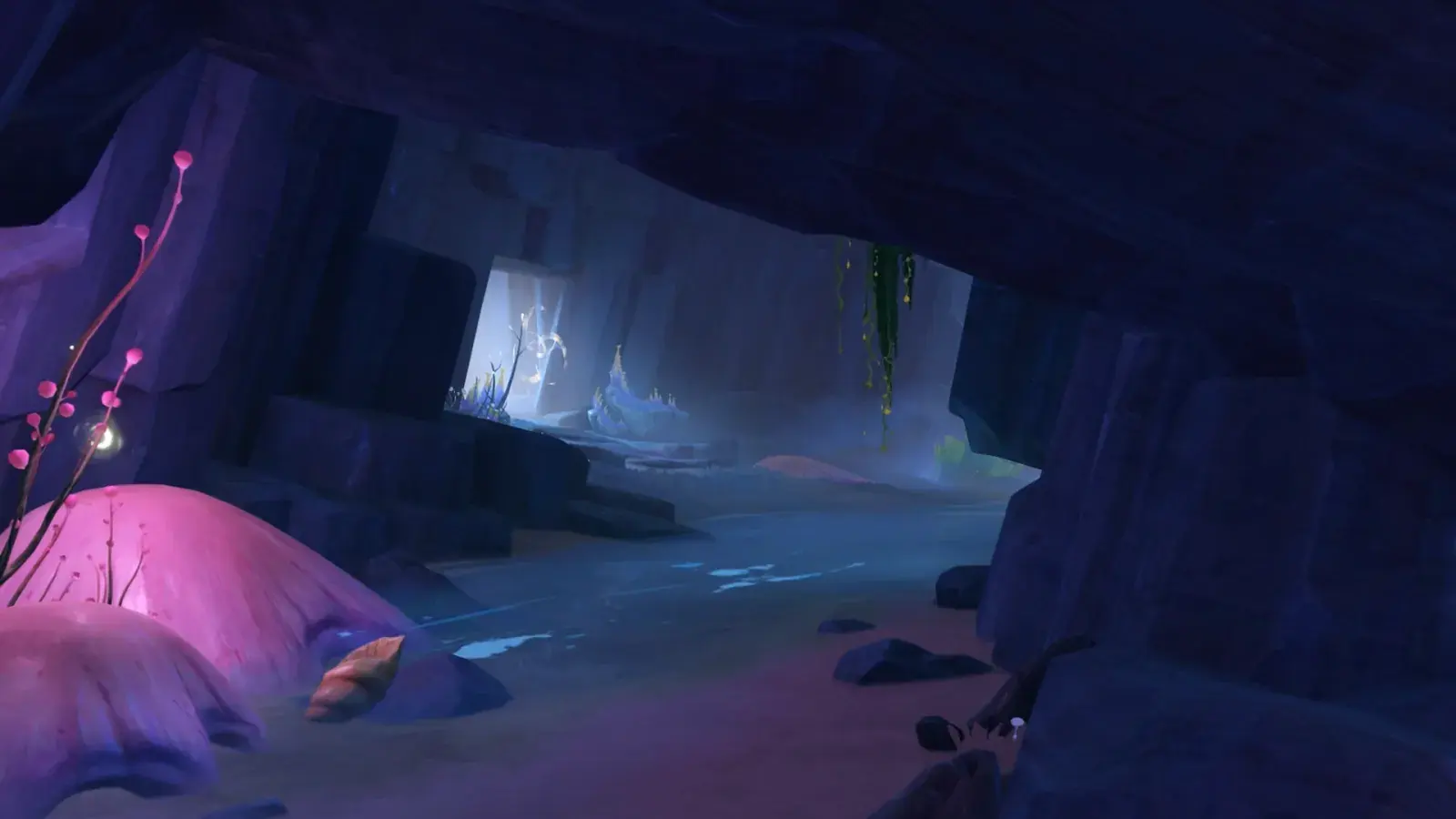
Paha Isle by Cavern Glow
Nod-KraiEnclosedDampFaint glow

Paha Isle by Cavern Glow

Palette

Click a swatch to copy its HEX; hover for the OKLCH value.

Reconstructed gradient

The gradient distilled from the scene, unrolled left to right by stop; the authored angle is 200° (used by the hero and exports), while gallery cards share a uniform 135° sweep.

0%0d102d26%27315144%879cc166%29466d100%b961aa

Why it works

What takes over the ambient colour when there is no daylight — this batch answers it three ways, and this study answers on the axis of depth. «Wenut Tunnels by Sandlight» says hue belongs to the light rather than to the material; «Ashveil Peak, Cavern Glow» says light and colour come from two different sources. The pivot here is that lightness, as a lever, has already been used up on how far a surface sits from a light: four layers of rock from near to far measure L 0.26 → 0.22 → 0.24 → 0.32 and double back twice, while the chroma of that same rock runs 0.076 → 0.068 → 0.057 → 0.059 and never turns around. Depth has to be moved onto chroma wholesale.

01

Two lights, same brightness, one colour

The brightest 4000 pixels in the frame split into two clumps. 2,957 sit on the narrow slot flattened under the rock overhang in the middle ground (0.35, 0.45), averaging L 0.82, chroma 0.055; 687 sit on the mushroom cap glowing from the inside at lower left (0.09, 0.71), L 0.81, chroma 0.141. The lightness gap is 0.01; the chroma gap is 2.6 times. The eye reads the cap as the near light and the slot as the far one without a moment's hesitation — air eats chroma, not brightness. To set two lights in one space apart in depth, do not reach for brightness; make the nearer one more saturated first.

02

Lightness records distance from the light

The rock overhang across the top of the frame is the closest thing to the lens and the darkest surface in the picture (L 0.19); the farthest rock, beside the slot, is the brighter of the two (L 0.32). Measured in four layers from near to far, lightness 0.26 → 0.22 → 0.24 → 0.32 doubles back twice, chroma 0.076 → 0.068 → 0.057 → 0.059 falls monotonically, and hue stays shut between 282° and 270° throughout. «Jueyun Karst at Dawn» builds its aerial perspective as a 0.36 → 0.92 lightness staircase; «Nostoi Region in Hazy Daylight» uses two opposed gradients, lightness 0.72 → 0.87 against chroma 0.106 → 0.079 — both still had lightness as a lever. The cave does not. With no daylight arriving, lightness has all it can do to record which surface got lit. In the other two caves of this same group a different channel is the one used up: in «Wenut Tunnels by Sandlight» a single sandstone runs its hue monotonically 47° from the lit column face up to the roof while chroma drops to a quarter (quoted from that study) — there it is hue that reads the light; in «Ashveil Peak, Cavern Glow» the opening measures chroma 0.034, exactly the frame's chroma median (quoted from that study) — there the brightest place hands over no colour at all. Same absence of daylight: measure which channel the light source has already spent, then hang depth on whichever one is still free.

03

All the chroma bought one mushroom

The violet band, 65.71% (279°, chroma 0.066), and the blue band, 28.52% (263°, 0.064), take 94.23% of the frame. The pink band is only 4.91%, yet carries chroma 0.132 — twice theirs. Of the 4000 most chromatic pixels, 3,999 fall in 330°–360° (mean 339°, chroma 0.173, peak 0.232), all of them on that cap and the string of slender stalk-lamps rising from it. The trodden warm sand at bottom right measures 296°; the vines hanging on the right that read as yellow-green yield only 633 pixels inside the 60°–180° window of their rect (164°, chroma 0.032, barely over the grey threshold); the whole frame holds 19 pixels in 15°–90°. The study above ground, «Paha Isle at Dusk Glow», has a chroma median of 0.107 and a lightness median of 0.51; here they are 0.062 and 0.23 — the same island, the dominant hue moved only from 286° to 279°, and yet both channels were cut down by more than four-tenths. Chroma is the one depth channel this picture has, so it cannot be handed out everywhere.

Take these colours with you

CSS variables, a Tailwind v4 theme or SVG — one click to copy into your project.

/* Paha Isle by Cavern Glow · Paha Isle by Cavern Glow — Teyvat Palette */
:root {
  --vault-violet: oklch(0.19 0.057 274); /* Vault Violet #0d102d */
  --near-wall: oklch(0.26 0.076 282); /* Near Wall #1f1d47 */
  --far-rock: oklch(0.32 0.059 270); /* Far Rock #273151 */
  --far-slot: oklch(0.69 0.06 262); /* Slot Light #879cc1 */
  --cap-glow: oklch(0.62 0.145 334); /* Cap Glow #b961aa */
  --spire-blue: oklch(0.51 0.079 260); /* Spire Blue #4b6693 */
  --floor-rill: oklch(0.39 0.076 257); /* Floor Rill #29466d */
  --gradient-lunar-treasury-paha-isle-location-context: linear-gradient(200deg, oklch(0.19 0.057 274) 0%, oklch(0.32 0.059 270) 26%, oklch(0.69 0.06 262) 44%, oklch(0.39 0.076 257) 66%, oklch(0.62 0.145 334) 100%);
}

A 1080×1350 PNG carrying the scene, its palette and every value — save it and post it as is.