Teyvat PaletteTeyvat colour cards
Scene library
GitHub
Gallery
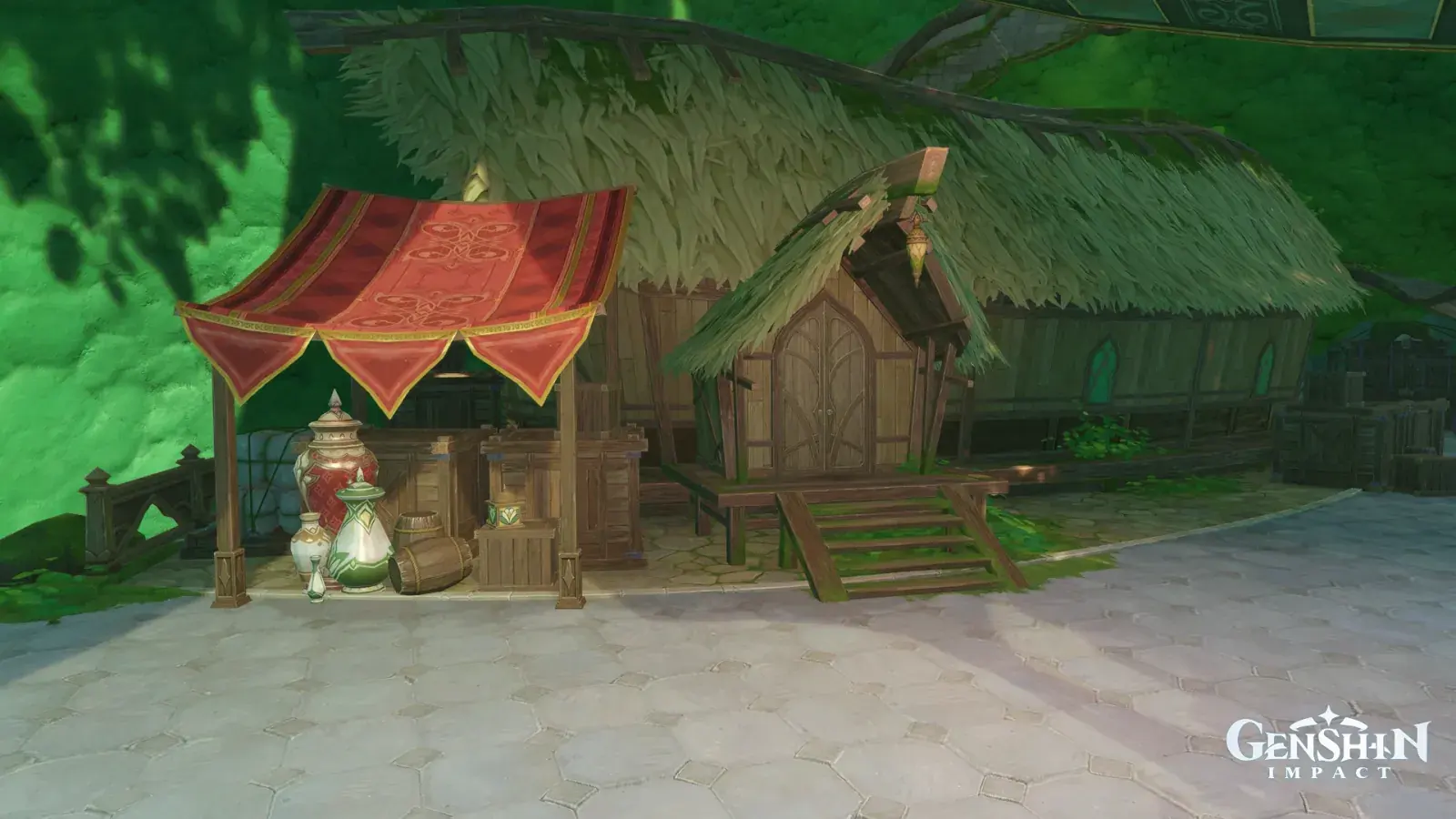
Acara Crafts in Plain Shade
SumeruDayDeep GreenDampUndyed

Acara Crafts in Plain Shade

Palette

Click a swatch to copy its HEX; hover for the OKLCH value.

Reconstructed gradient

The gradient distilled from the scene, unrolled left to right by stop; the authored angle is 180° (used by the hero and exports), while gallery cards share a uniform 135° sweep.

0%15492130%479c4d55%b0564072%645237100%acaca0

Why it works

A light with no colour is a colour-rendering meter: the same skylight, falling on a mossed cliff, grows more chromatic as it grows brighter (leaf-shadowed stretch L 0.36 / chroma 0.087 → lit stretch L 0.64 / 0.144), and falling on the paving of the square, grows greyer as it grows brighter (four rectangles along the bottom edge, left to right, L 0.68 / 0.73 / 0.75 / 0.77 against chroma 0.024 / 0.016 / 0.016 / 0.018). Within one picture the sign of the lightness-chroma correlation can point opposite ways on two surfaces — and what that sign reads is not the light, but whether the material has a hue of its own.

01

The brightest ground has the least colour

Sampled as one block, the paving of the square is 119,952 pixels averaging chroma 0.020 with a maximum of only 0.037 — the entire surface held under the achromatic line of 0.025. And yet its lightness, 0.72, sits a full 0.29 above the frame's median of 0.43, making it the brightest large surface in the picture. Almost all of the frame's 22.37% achromatic is this one slab. It was not desaturated into that state: four equal rectangles along the bottom edge read, left to right, L 0.68 / 0.73 / 0.75 / 0.77, chroma 0.024 / 0.016 / 0.016 / 0.018, hue 144° / 132° / 95° / 76° — the closer to the green cliff on the left, the more colour there is, and the further the hue leans toward the cliff's 145°. Step out of the bounce and the paving gives up its hue. If you want a dependable neutral over a large area, do not go turning saturation down; pick a material that has no hue to begin with and push it into the light that has none either.

02

One light, two signs

The mossed cliff takes 60.37% of the frame, the largest single thing in it. Follow the same cliff from its leaf-shadowed upper stretch down into the light: L 0.36 → 0.45 → 0.64, chroma 0.087 → 0.106 → 0.144 — lightness and chroma moving together, a rise of 1.66 times. The paving moves the other way. Both surfaces take the same light, so the difference is not on the light's side: a light with no colour cannot bring colour in, it can only enlarge what the material already has — enlarging a hue-bearing material to 0.144 and a hueless one to 0.016. If you want a picture to hold both a saturated place and a large neutral one, you do not need a second lamp. Let the two kinds of material take the same one.

03

The paving has only two roads

The 165°-wide window from 210° to 15° holds just 36 pixels across the whole frame, 0.004% — not one cold pixel. So the paving has exactly one hue it can report: the green of the cliff. The only coloured light in the picture is that cliff's bounce, and the 4000 most chromatic pixels land 4000/4000 on it (146°, chroma 0.162). Measured with the same ruler, the red awning over the stall reads 0.137 / 32° across its most chromatic 3% — a step below the cliff's 0.163. The most chromatic place in this frame is not the red cloth a person hung up, it is the stone with moss growing on it. «Land of Lower Setekh in Thin Daylight» measured the ceiling of this same law ("to find the most chromatic place, do not look at where the sun falls, look at where it does not"). This picture measures its floor: the surface facing the white light square-on is not merely under-saturated, it drops out of the hue wheel entirely.

Take these colours with you

CSS variables, a Tailwind v4 theme or SVG — one click to copy into your project.

/* Acara Crafts in Plain Shade · Acara Crafts in Plain Shade — Teyvat Palette */
:root {
  --moss-cliff-green: oklch(0.62 0.14 145); /* Mossy Cliff Green #479c4d */
  --leaf-shadow-green: oklch(0.36 0.087 148); /* Leaf-Shadow Green #154921 */
  --plain-paving: oklch(0.74 0.017 105); /* Plain Paving #acaca0 */
  --awning-red: oklch(0.56 0.123 35); /* Awning Red #b05640 */
  --thatch-straw: oklch(0.45 0.047 76); /* Thatch Straw #645237 */
  --glazed-jar: oklch(0.85 0.042 112); /* Glazed Jar White #ced1b2 */
  --gradient-location-acara-crafts: linear-gradient(180deg, oklch(0.36 0.087 148) 0%, oklch(0.62 0.14 145) 30%, oklch(0.56 0.123 35) 55%, oklch(0.45 0.047 76) 72%, oklch(0.74 0.017 105) 100%);
}

A 1080×1350 PNG carrying the scene, its palette and every value — save it and post it as is.