Teyvat PaletteTeyvat colour cards
Scene library
GitHub
Gallery
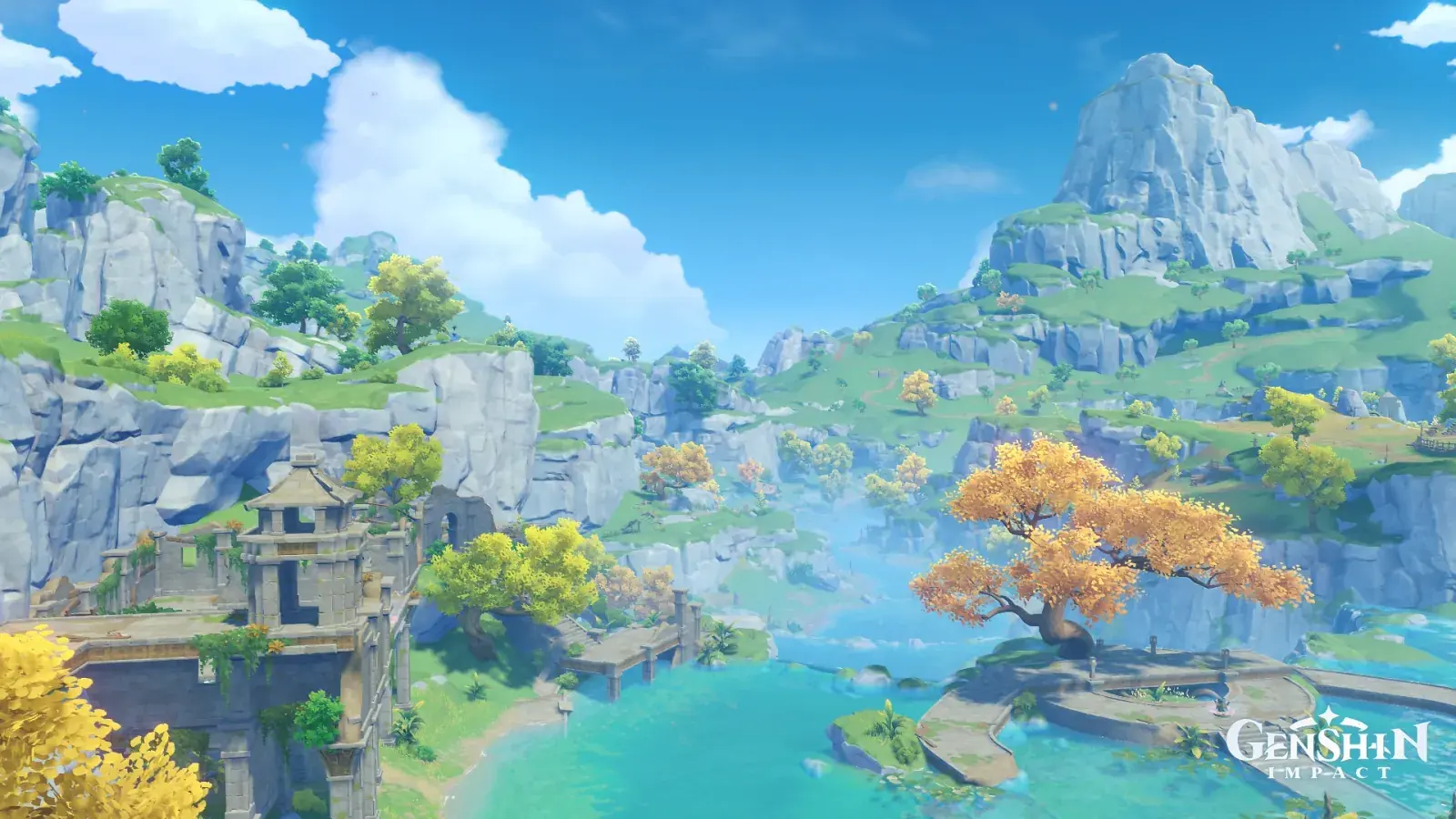
Lisha in Golden Daylight
LiyueDayBrightVerdantFresh

Lisha in Golden Daylight

Palette

Click a swatch to copy its HEX; hover for the OKLCH value.

Reconstructed gradient

The gradient distilled from the scene, unrolled left to right by stop; the authored angle is 180° (used by the hero and exports), while gallery cards share a uniform 135° sweep.

0%3195d318%defcff40%92b8c762%95b37b82%f0d957100%4ab1af

Why it works

Area and top-of-the-range bulk can be awarded to two different hue families without a single chroma statistic changing: blue holds 529,098 pixels against green's 115,260 (4.6 times), and the two families average chroma 0.083 and 0.084. Yet of the 4000 most saturated pixels, green takes 3,244 and blue only 573. The ground colour is set by area, the focus by how thick the cluster pressed against the ceiling is — and here those two run opposite ways.

01

Four and a half times the area, a sixth of the top

The blue band (210°–270°) holds 529,098 pixels, mean chroma 0.083, peak 0.162. The green band (90°–165°) holds 115,260, mean 0.084, peak 0.181. The areas differ by 4.6 times, the mean chromas by 0.001, the peaks by 0.019 — every way of measuring 'which is more saturated' calls it a draw. What actually separates them is who owns the 4000 most saturated pixels: green 3,244, blue 573. And those two clusters average 0.152 and 0.148 themselves, level again. The difference was never density. It is thickness.

02

Favonius Cathedral left one split undone

〈Favonius Cathedral under a Clear High Sky〉 proved that Cmax is not a personality by having banners covering 0.35% match every chroma statistic of a sky covering 70.33%. But in that picture the same family took both the area and the bulk at the top — of the 4000 most saturated, sky 3,229 against banners 678 — which is why 'the lead colour is bought by the bulk of that cluster' held there. Lisha pulls the two apart: the lead is still blue, at 60.09% of the frame, and its zenith measures L 0.64 / chroma 0.129, genuinely the deepest and most saturated large surface in the picture. The bulk at the top is green's. When you report the weight of a hue family, report area and top-of-the-range bulk separately — they can run opposite ways, and no chroma statistic will notice.

03

The two densest clusters share one vertical line

Those 3,244 pixels grow on the sunlit crown of the yellow tree at lower left: the most saturated 3% of that same rectangle — from (0.05, 0.72), 0.12 wide and 0.22 tall — measures L 0.88 / chroma 0.149 / hue 99°. Measure the larger yellow tree at mid right the same way and it reaches only 0.119 / 91°, so the thick one is this smaller tree at lower left, not the big one. The sky's densest 573 pixels land at (0.16, 0.09), the zenith, at L 0.67 / chroma 0.148 / 245° — the two clusters sit almost on one vertical line, one at the zenith and one in a treetop, 0.004 apart in density. To make something small the focus, do not go after its peak (0.181 against 0.162 is a difference of 0.019). Go and thicken the cluster it presses against the ceiling: one sunlit crown is enough, while a whole sky produced 573.

Take these colours with you

CSS variables, a Tailwind v4 theme or SVG — one click to copy into your project.

/* Lisha in Golden Daylight · Lisha in Golden Daylight — Teyvat Palette */
:root {
  --zenith-blue: oklch(0.64 0.129 241); /* Zenith Blue #3195d3 */
  --cumulus-white: oklch(0.97 0.031 208); /* Cumulus White #defcff */
  --karst-grey: oklch(0.76 0.046 224); /* Karst Grey #92b8c7 */
  --bay-teal: oklch(0.7 0.095 193); /* Bay Teal #4ab1af */
  --slope-green: oklch(0.73 0.084 131); /* Slope Green #95b37b */
  --crown-gold: oklch(0.88 0.149 99); /* Crown Gold #f0d957 */
  --gradient-lisha: linear-gradient(180deg, oklch(0.64 0.129 241) 0%, oklch(0.97 0.031 208) 18%, oklch(0.76 0.046 224) 40%, oklch(0.73 0.084 131) 62%, oklch(0.88 0.149 99) 82%, oklch(0.7 0.095 193) 100%);
}

A 1080×1350 PNG carrying the scene, its palette and every value — save it and post it as is.