Teyvat PaletteTeyvat colour cards
Scene library
GitHub
Gallery
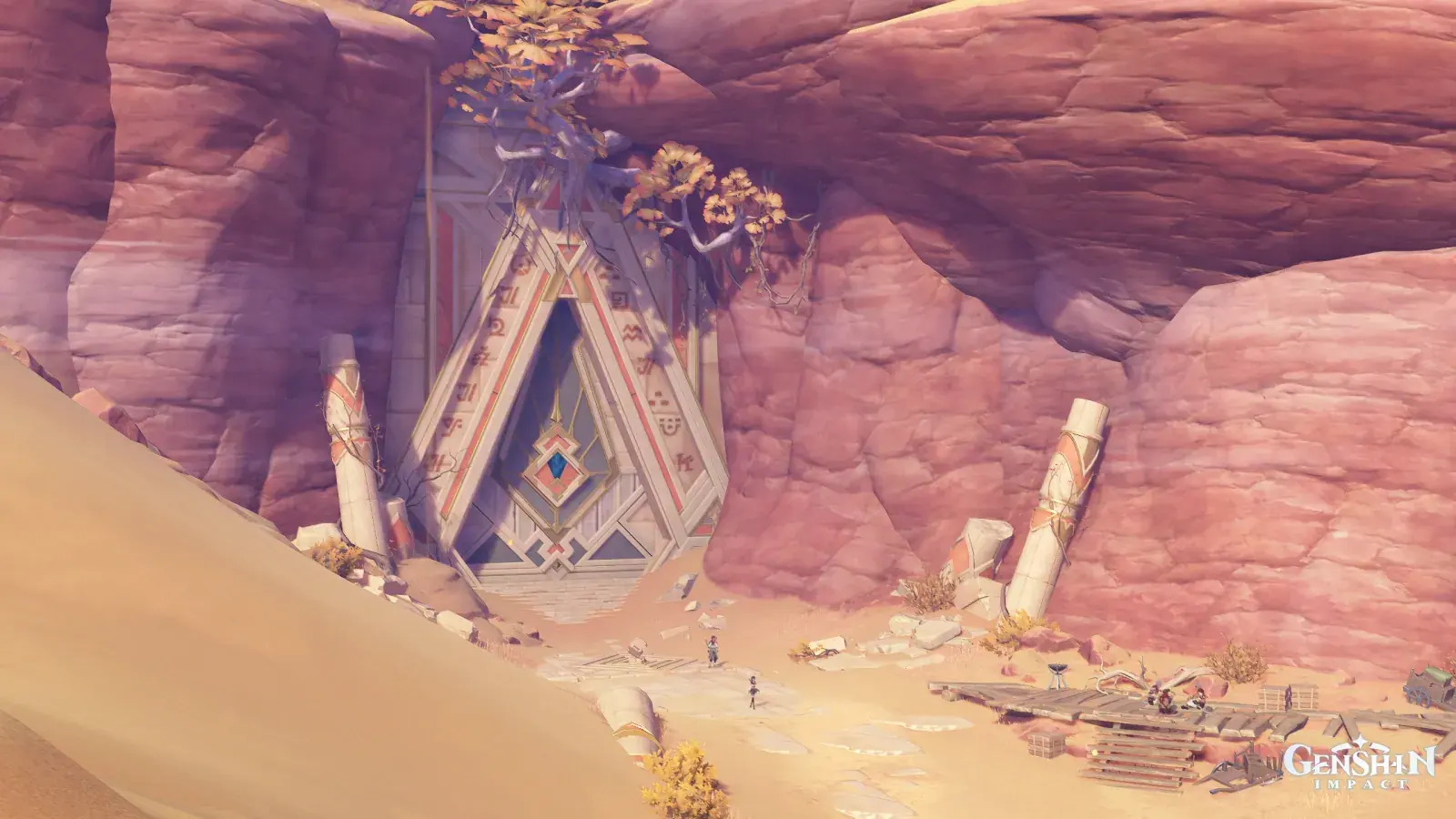
Lamb-Devourer Rock in Rosy Haze
SumeruDayDesolateDry HeatOchre Warmth

Lamb-Devourer Rock in Rosy Haze

Palette

Click a swatch to copy its HEX; hover for the OKLCH value.

Reconstructed gradient

The gradient distilled from the scene, unrolled left to right by stop; the authored angle is 180° (used by the hero and exports), while gallery cards share a uniform 135° sweep.

0%70486a28%995d6e62%ce8a82100%e8bf96

Why it works

Charge the shadow's difference to hue and chroma pays nothing at all. In Lamb-Devourer Rock the same sandstone reads 333° / L 0.43 / C 0.079 in its deepest cleft and 29° / L 0.76 / C 0.080 on the sunlit face — hue walks 56°, lightness walks 0.33, and chroma differs by 0.001. In 〈Wenut Tunnels by Sandlight〉 the same kind of sandstone also walks its hue monotonically (47°), but there chroma falls to a quarter, because there the light is running out. Which means the reverse test works: whether chroma dropped tells you whether the dark in a picture is shadow or shortage of light.

01

Five hue bands, one ramp of lightness

98.42% of the frame is split between four adjacent hue bands: pink 15.94% (333°), red 24.82% (2°), orange 29.25% (27°), yellow 28.41% (63°) — with 1.47% of violet (307°) tacked on at the dark end. The mean lightness of those five bands climbs monotonically, 0.43 / 0.46 / 0.55 / 0.70 / 0.78, while their chroma reads 0.070 / 0.073 / 0.081 / 0.084 / 0.074, a spread of 0.014. In this picture hue is the lightness scale: name the hue of a piece of sandstone and you have named how bright it is.

02

Shadow does not spend chroma; running out of light does

Three samples off the same cliff: the deepest cleft at upper left (from (0.20, 0.20)) 333° / L 0.43 / C 0.079; the left-hand face (from (0.03, 0.05)) 0° / 0.54 / 0.086; the sunlit face on the right (from (0.88, 0.35)) 29° / 0.76 / 0.080. Lightness crosses 0.33 and chroma spreads by 0.007. In the tunnel of 〈Wenut Tunnels by Sandlight〉 the same sandstone walks 47° of hue and drops to a quarter of its chroma — that is light being used up. Here light is plentiful, and the dark end simply retreats a few degrees along the hue arc toward magenta. It also explains why this picture cannot produce a single patch of grey: achromatic 0.08% — a shadow that never passes through neutral cannot make one.

03

The white is on the arc too

The stone gate that looks snow-white measures L 0.66 / C 0.060 / 17° (from (0.31, 0.30)) — it has not left the arc, it has merely taken a paler point on it, below the frame's median chroma of 0.080. The only thing that truly leaves is the gem at the gate's heart: the window `100°–285°`, 185° wide, holds 257 pixels in the whole frame, and 211 of them are that gem (from (0.33, 0.50), L 0.45 / C 0.083 / 257°) — 0.024% of the picture, at almost exactly the median chroma. To place a focus in a frame ruled by one hue ramp, first put every material honestly onto the ramp, the ones you thought were white included, then carry exactly one of them all the way off it.

Take these colours with you

CSS variables, a Tailwind v4 theme or SVG — one click to copy into your project.

/* Lamb-Devourer Rock in Rosy Haze · Lamb-Devourer Rock in Rosy Haze — Teyvat Palette */
:root {
  --cleft-rose: oklch(0.46 0.073 333); /* Cleft Rose #70486a */
  --red-wall: oklch(0.55 0.081 2); /* Red Wall #995d6e */
  --ochre-cliff: oklch(0.7 0.084 27); /* Ochre Cliff #ce8a82 */
  --sunlit-sand: oklch(0.79 0.074 63); /* Sunlit Sand #ddb189 */
  --gate-pale: oklch(0.66 0.06 17); /* Gate Pale #b48485 */
  --gem-blue: oklch(0.45 0.083 257); /* Gem Blue #365683 */
  --gradient-lamb-devourer-rock: linear-gradient(180deg, oklch(0.46 0.073 333) 0%, oklch(0.55 0.081 2) 28%, oklch(0.7 0.084 27) 62%, oklch(0.83 0.072 67) 100%);
}

A 1080×1350 PNG carrying the scene, its palette and every value — save it and post it as is.