Teyvat PaletteTeyvat colour cards
Scene library
GitHub
Gallery
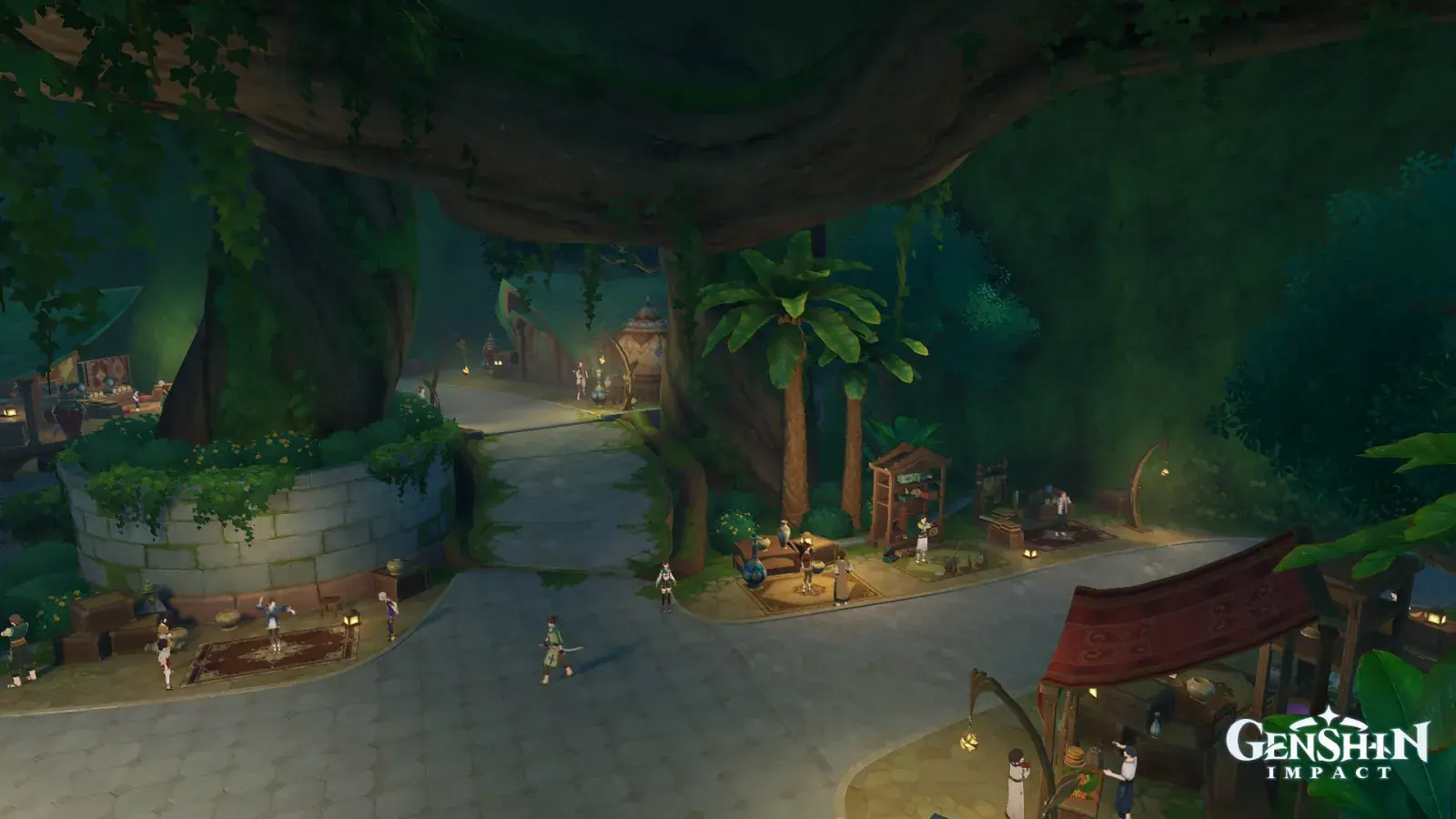
Grand Bazaar, Lamps in the Shade
SumeruDeep ShadeBustlingLamp-Warm

Grand Bazaar, Lamps in the Shade

Palette

Click a swatch to copy its HEX; hover for the OKLCH value.

Reconstructed gradient

The gradient distilled from the scene, unrolled left to right by stop; the authored angle is 180° (used by the hero and exports), while gallery cards share a uniform 135° sweep.

0%0c1c1718%0e281b48%3d484566%3b2d2584%4f4730100%655635

Why it works

Whether a lamp can be seen depends on how many accounts are still open on the surface it lights. The paving of the Grand Bazaar has no colour of its own — two patches of road that no lamp reaches, 3,311 and 5,871 pixels, both measure chroma 0.015, with maxima of only 0.021 and 0.023: not one pixel crosses the achromatic line at 0.025. The ground at the foot of the lamp post, meanwhile, climbs to chroma 0.038 and swings its hue from 193° to 92°, while lightness moves only from 0.38 to 0.40. The ground in «Schulz's Blacksmith by Forge Light» is daylight cyan, so the difference can only be charged to hue; the ground in «Great Hall of Truths by Brazier Light» is already the fire's own warm, so it can only be charged to chroma. Here the ground is nothing at all, so both accounts are charged at once. Paving a road achromatic is not modesty — it is leaving every lamp two channels to spend. And the lightness channel is one all three pictures leave untouched.

01

The road is brighter than the leaves, and emptier

Three patches of unlit paving: 3,311 pixels mid-frame at L 0.38 / chroma 0.015, 5,871 pixels along the bottom edge at L 0.40 / 0.015, and 10,440 pixels in the lower-left corner at L 0.52 / 0.019 — lightness ranges over 0.14 while chroma does not move at all, and the first two top out at 0.021 and 0.023, with not a single pixel over the line. The foliage on either side of the same picture measures L 0.25 / 0.040 and L 0.25 / 0.039. So this road is not "too dark to have colour": it is 0.13 to 0.27 brighter than the leaves and emptier than they are. To decide whether a grey is a material with no hue of its own, do not look at how dark it is — find something in the same picture that is as bright or darker, and compare chroma.

02

A lamp is two accounts, and lightness is not one of them

The ground at the foot of the lamp post: 2,368 pixels at L 0.40 / chroma 0.038 / hue 92°. The unlit stretch in the same horizontal band: 3,311 pixels at L 0.38 / 0.015 / 193°. Chroma goes up 2.5 times, hue swings 101°, and lightness rises 0.02. The 5,253 pixels in front of the lower-right stall read L 0.46 / 0.053 / 86°, only 0.06 brighter than paving at the same height. In «Schulz's Blacksmith by Forge Light» the same paving measures 194° in the sun, 190° under the shed and 49° in front of the forge mouth, with every ΔL inside 0.05 and ΔC inside 0.005 — that ground was daylight cyan, and hue was all it had to trade. In «Great Hall of Truths by Brazier Light» the ground was already the fire's warm, hue moved only 22°, and the whole difference went to chroma. This picture supplies the third case: when the ground has no colour of its own, both accounts can be charged together. In all three, lightness is never touched — never light the ground under a lamp by brightening it.

03

The goods have no colour; the colour is the lamp map

The red cloth awning at lower right, which looks vividly red, measures L 0.31 / chroma 0.026 / hue 49° over 13,325 pixels — 0.001 above the achromatic line and below the frame's own median chroma of 0.031. The most merchandise-like colour in this market is paler than the median of its own picture. The warm span 330°–90° holds 71,801 pixels in total (8.15%), and even its most chromatic 3% only reaches 0.094. The brightest 4000 pixels, by contrast, never gather: the largest cluster is 1,035 pixels, the leading seven come to 3,330 spread over seven separate cells, and every hue is locked inside the narrow band 69°–96° — not one light source but seven lamps. In a place built for selling things, not one of the goods has a colour of its own — which makes the chroma distribution a map of where the lamps are. To paint a night market, do not push the saturation of the wares; place the lamps, and pave the ground they fall on with something that has no hue.

Take these colours with you

CSS variables, a Tailwind v4 theme or SVG — one click to copy into your project.

/* Grand Bazaar, Lamps in the Shade · Grand Bazaar, Lamps in the Shade — Teyvat Palette */
:root {
  --canopy-ink: oklch(0.21 0.024 170); /* Canopy Ink #0c1c17 */
  --leaf-wall: oklch(0.25 0.04 161); /* Leaf Wall #0e281b */
  --awning-red: oklch(0.31 0.026 49); /* Awning Red #3b2d25 */
  --unlit-paving: oklch(0.39 0.015 178); /* Unlit Paving #3d4845 */
  --lamplit-paving: oklch(0.4 0.038 92); /* Lamplit Paving #4f4730 */
  --stall-glow: oklch(0.46 0.053 86); /* Stall Glow #655635 */
  --gradient-grand-bazaar: linear-gradient(180deg, oklch(0.21 0.024 170) 0%, oklch(0.25 0.04 161) 18%, oklch(0.39 0.015 178) 48%, oklch(0.31 0.026 49) 66%, oklch(0.4 0.038 92) 84%, oklch(0.46 0.053 86) 100%);
}

A 1080×1350 PNG carrying the scene, its palette and every value — save it and post it as is.