Teyvat PaletteTeyvat colour cards
Scene library
GitHub
Gallery
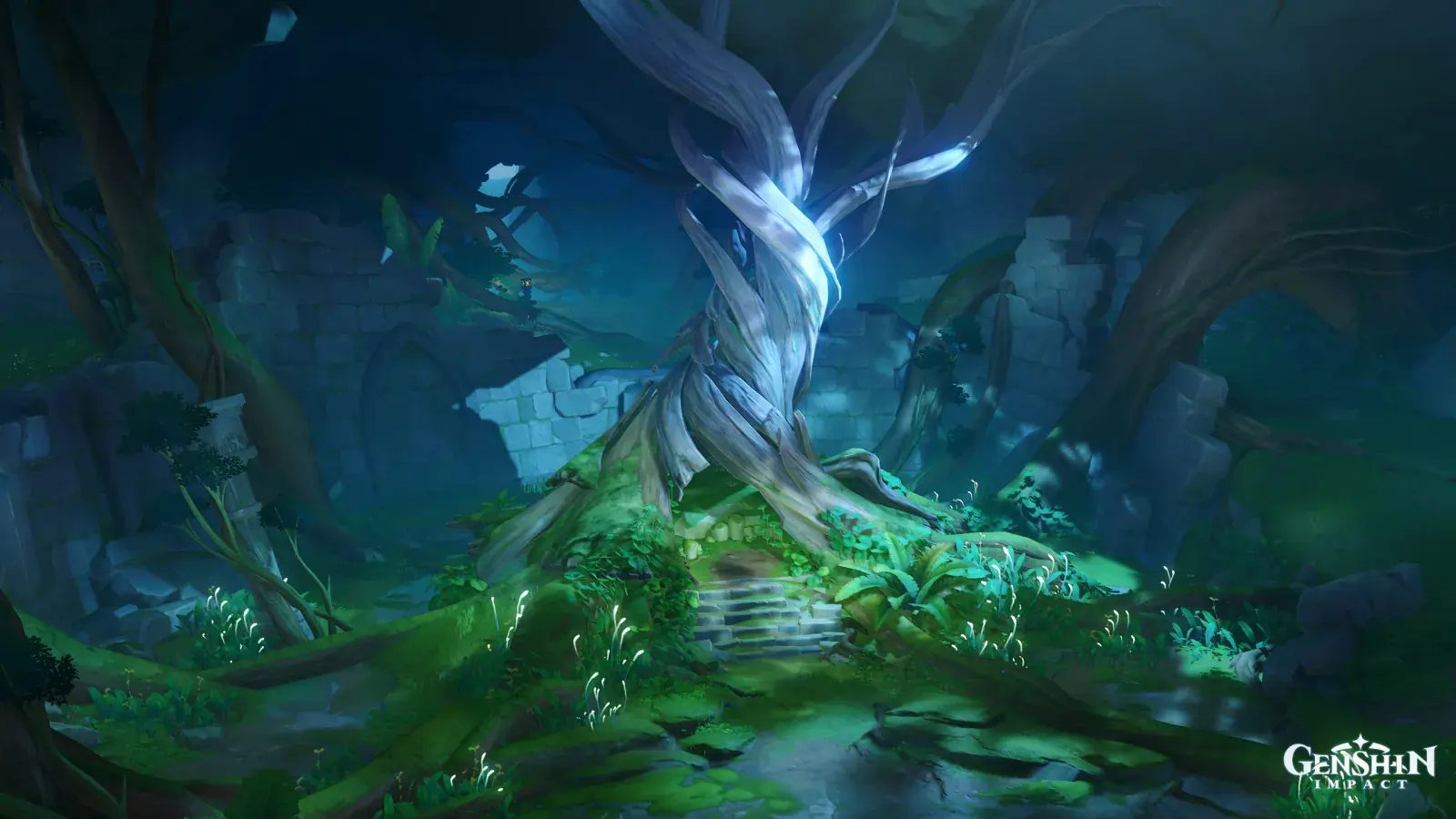
Fane of Ashvattha, Moonpale
SumeruNightDeep-shadedDew-dampReverent

Fane of Ashvattha, Moonpale

Palette

Click a swatch to copy its HEX; hover for the OKLCH value.

Reconstructed gradient

The gradient distilled from the scene, unrolled left to right by stop; the authored angle is 180° (used by the hero and exports), while gallery cards share a uniform 135° sweep.

0%021b2922%b5ecfb50%0f3a5072%125a46100%40ab58

Why it works

Night is not daylight turned down, it is half the colour wheel deleted: the Fane of Ashvattha has a median lightness of 0.32, the highest of the four halls in this set — brighter than Bayt Al-Hayah's 0.25 down in its cave — and it is still the only one of them that reads as night without being explained. The difference is on the hue ledger: the whole frame holds not a single pixel between 270° and 90°, and even the two great trees on the left and right edges that read as brown wood measure 220° and 223°. The remaining 95.81% is shut inside the other half, 90°–270°. To paint night, first decide which half of the wheel is not allowed to appear; lightness comes afterwards.

01

The brown trees are blue

The great tree at the left edge measures L 0.22 / hue 220°, the one at the right edge L 0.25 / 223°, the thick bough crossing in from the right L 0.29 / 218° — all three read as brown wood, all three land in blue. Search the whole frame from 270° to 90°, the entire half-circle through red, orange and yellow, at the caliber of «Brightcrown Mountains in Plain Daylight», and the answer is "nothing matched": not one pixel reaches the achromatic threshold. That study found 2 pixels in a 60°-wide window; this one finds 0 in a 180°-wide window. Wood's local colour is warm, and it only surrenders it when the lighting carries no warm component at all. The hardest thing to delete in a night scene is never the sky — it is everything you assume "just is that colour": wood, brick, skin. They have to give up their hue too.

02

It is the brightest of the four

The four halls have median lightness 0.25 for Bayt Al-Hayah, 0.30 for Bayt Al-Sukr, 0.30 for Bayt Al-Muazzam and 0.32 here; the lightness allowances (p99 minus each picture's own median, the method of «Belleau Region in Limpid Daylight») are 0.34 / 0.39 / 0.37 / 0.45, and this frame leads on both counts. It is brighter than all three caves, and it is the only one of the four that reads as night at a glance. The mechanism is that "dark" is relative while the hue ledger is not: a picture with median lightness 0.32 could be dusk, or overcast, or underground, or underwater — but as long as 270°–90° is empty, it can only be night. To judge whether a night scene is night enough, don't look at the left end of the histogram; count the warm pixels.

03

Use up the half that is left

Deleting half is not a demotion to monochrome: inside the remaining 180°, green covers 16.58%, cyan 18.87% and blue 60.36% — 95.81% together, with only 4.19% achromatic and not a step left empty. And the two extremes are handed to opposite ends of that span: of the 4000 brightest pixels, 2478 fall in one cell at the crown of the pale tree (L 0.91 / chroma 0.059 / hue 217°), while the most saturated cluster is on the grass slope at its foot (L 0.66 / chroma 0.155, the frame's peak 0.187 / hue 148°) — 69° apart. One beam of moonlight yields lightness on high-reflectance bark and chroma on a leaf surface; and reflection can never afford what emission costs — this frame's chroma allowance of 0.073 is four tenths of the 0.173 that Bayt Al-Sukr's two self-lit flowers buy. Having narrowed the gamut, stop economising: fill the span that is left, and put the brightest thing and the most saturated thing at its two ends.

Take these colours with you

CSS variables, a Tailwind v4 theme or SVG — one click to copy into your project.

/* Fane of Ashvattha, Moonpale · Fane of Ashvattha, Moonpale — Teyvat Palette */
:root {
  --moonpale-bough: oklch(0.91 0.059 217); /* Moonpale Bough #b5ecfb */
  --moss-slope: oklch(0.66 0.155 148); /* Moss Slope #40ab58 */
  --glade-cyan: oklch(0.42 0.077 169); /* Glade Cyan #125a46 */
  --ruin-blue: oklch(0.33 0.06 236); /* Ruin Blue #0f3a50 */
  --ironwood-blue: oklch(0.22 0.03 220); /* Ironwood Blue #081e24 */
  --canopy-night: oklch(0.21 0.042 237); /* Canopy Night #021b29 */
  --gradient-fane-of-ashvattha: linear-gradient(180deg, oklch(0.21 0.042 237) 0%, oklch(0.91 0.059 217) 22%, oklch(0.33 0.06 236) 50%, oklch(0.42 0.077 169) 72%, oklch(0.66 0.155 148) 100%);
}

A 1080×1350 PNG carrying the scene, its palette and every value — save it and post it as is.