Teyvat PaletteTeyvat colour cards
Scene library
GitHub
Gallery
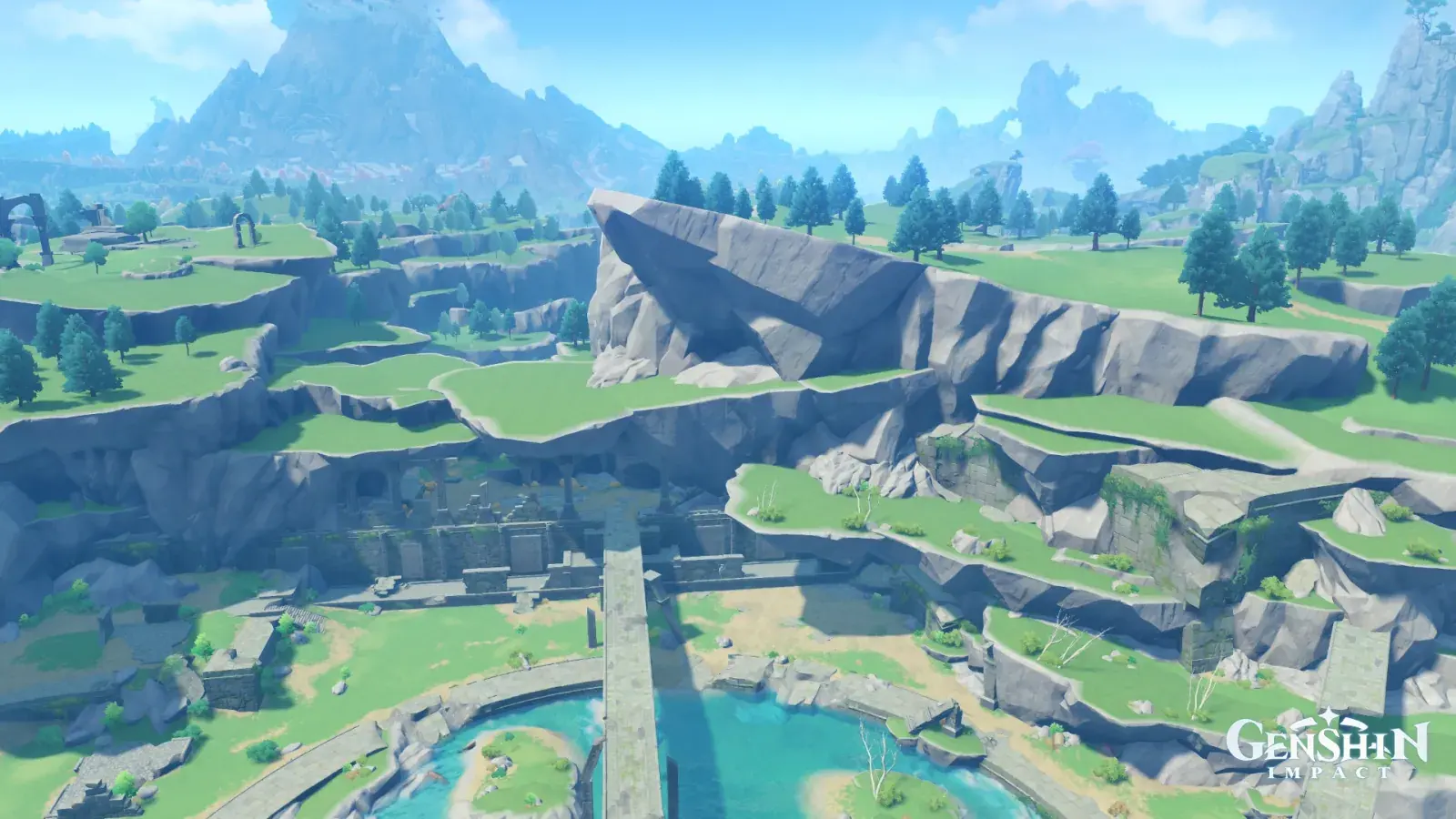
Brightcrown Mountains in Plain Daylight
MondstadtDayPlainLayeredHushed

Brightcrown Mountains in Plain Daylight

Palette

Click a swatch to copy its HEX; hover for the OKLCH value.

Reconstructed gradient

The gradient distilled from the scene, unrolled left to right by stop; the authored angle is 180° (used by the hero and exports), while gallery cards share a uniform 135° sweep.

0%9cdbfa28%6daece55%467c9578%609b9a100%79b39f

Why it works

A frame can also be made by brightening. The four edges read L 0.87 / 0.71 / 0.71 / 0.65, every one of them on the light side of the centre's 0.61, while the same four edges' chroma — 0.075 / 0.066 / 0.063 / 0.074 — brackets the centre's 0.066 from both sides. Four edges leaving the centre together, on one axis, is what makes a frame; an axis whose edges straddle the centre is just terrain.

01

All four edges stand on the light side

Top edge L 0.87, bottom 0.71, right 0.71, left 0.65; the central 0.3×0.3 patch is 0.61 — the smallest of them still clears it by 0.04, the largest by 0.26. The four corners, 0.88 / 0.85 / 0.74 / 0.64, are likewise all on the light side without exception. The familiar vignette darkens the edges to push the eye inward; this picture does the reverse and still reads as a frame. Which side of the centre the edges land on does not matter. That all four land on the same side does.

02

Chroma straddles the centre, so it is not the frame

The four edges measure chroma 0.075 / 0.066 / 0.063 / 0.074 against the centre's 0.066 — two above, one level, one below. Sliced into ten horizontal bands, chroma only swings 0.025, between 0.057 and 0.082, while lightness falls from 0.86 to 0.56 and climbs back to 0.72. Hue offers even less: exactly 2 pixels in the whole frame fall in 345°–45°, the red and orange bands are empty, and what remains are three adjacent steps — blue 60.58%, green 18.45%, cyan 10.30%. Two of the three axes are out, so the frame can only be drawn in lightness. 〈Windwail Highland under a Clear Zenith〉 is the mirror image: there lightness straddles the centre (four edges 0.69 / 0.59 / 0.72 / 0.61 against 0.70) and the frame is drawn in chroma.

03

The top edge is air, the bottom edge is water

The picture stacks six or seven terraces from bottom to top, each one a sheet of grass over a wall of rock; the shaded faces of the mid-frame walls all pile up here, measuring L 0.56. The brightness of the top edge comes from the atmospheric haze above the far mountains (L 0.87, hue 229°), the brightness of the bottom edge from that turquoise pool split by the stone bridge (L 0.75, hue 167°) and its shallows (L 0.69, chroma 0.046). A sheet of air and a pool of water have nothing to do with each other in this picture, yet they assemble into one frame purely by landing on the same side of lightness. A frame does not need matching materials — only matching signs on one axis.

Take these colours with you

CSS variables, a Tailwind v4 theme or SVG — one click to copy into your project.

/* Brightcrown Mountains in Plain Daylight · Brightcrown Mountains in Plain Daylight — Teyvat Palette */
:root {
  --haze-vault: oklch(0.87 0.074 229); /* Haze Vault #a1defb */
  --far-ridge: oklch(0.81 0.086 234); /* Far Ridge #88cbf0 */
  --mesa-green: oklch(0.77 0.078 143); /* Mesa Green #97c294 */
  --cliff-shadow: oklch(0.56 0.061 231); /* Cliff Shadow #4e7b92 */
  --pool-teal: oklch(0.75 0.059 167); /* Pool Teal #8abaa6 */
  --pale-shore: oklch(0.69 0.046 171); /* Pale Shore #7fa597 */
  --gradient-brightcrown-mountains: linear-gradient(180deg, oklch(0.86 0.077 229) 0%, oklch(0.72 0.081 230) 28%, oklch(0.56 0.069 229) 55%, oklch(0.65 0.062 194) 78%, oklch(0.72 0.067 171) 100%);
}

A 1080×1350 PNG carrying the scene, its palette and every value — save it and post it as is.